Wednesday, 1 May 2019

Art of darkness: Don McCullin at Tate Britain

I’m annoyed with myself for not managing to see this exhibition before its final week or so. Now I come to put my thoughts down, and there are literally a few days of the run left - it closes Monday 6 May (it’s a holiday weekend here in the UK). But all I can say is: if you’re reading this in time and you’re in the area, PLEASE try and catch this.

I think it’s one of the most important photographic exhibitions I’ve ever seen. By the end, I was a messy hybrid of admiration and emotion, close to tears. As with most gallery shows now, the exit door plants you straight in the shop - so I had to find a quiet corner and compose myself before facing the postcards, prams and public.

Don McCullin - surely one of the most renowned and distinctive photojournalists ever to practise the discipline - is not an obscure figure. Fortunately, for those of you who will miss this particular show, his images are widely known and circulated, not least in a number of celebrated books. (The catalogue for this exhibition, a relatively affordable Tate paperback, is as fine a way in as any.)


The chances are you will know many of his photographs even if the name had escaped you before now. Over a possibly unique career, relentless in its restlessness, McCullin has stared through his viewfinder into the abyss, over and over again. He has made a lifelong specialism of capturing conflict - with recognisably haunting shots from Vietnam, Cambodia, Cyprus, Ethiopia, the Lebanon and Northern Ireland - and crisis. His work depicting, for example, the victims of famine in Ethiopia, or the homeless in London’s East End reminds us that battles are being fought everywhere, whether or not there’s a war.

The cumulative effect of seeing this carnage-ridden career overview is almost enough to make you punch-drunk... and justifiably so, since McCullin’s work tells us, repeatedly, that these are the things human beings are capable of. Whatever part of the world you turn to, wherever there are people, there is suffering, cruelty and violence.

But to leave it there would be to do McCullin a grave disservice. A man of considerable eloquence and integrity, he has grappled with the moral dilemmas involved in his occupation - driven by a sense of responsibility to expose the truth of these horrors to the wider world - and openly discussed the toll it has taken on his mental health. The exhibition tackles these issues head on, mostly using McCullin’s own words in the accompanying texts.

But to the show’s credit, it avoids reinforcing the idea that McCullin has only produced visions of hell. The exhibition really brought home to me how he is clearly a naturally gifted, ‘born complete’ photographer, possessed of a genuinely unerring eye, right from the start. A room of early pictures contains the brilliantly inventive photo of his local gang, the Guvnors, framing each of them in a rogue’s gallery amid the collapsed rooms of a ruined house. The shot launched his professional career. Elsewhere, he captures a couple crossing the street in perfect step: each with one leg in sharp focus but with just a hint of blur on the other to inject the energy needed to give us the movement.


And later in life, drawing back from war zones, he has expanded his practice to include pure landscape photography, as well as creating still life compositions in his garden to take his mind away from more traumatic subjects. One of his recent projects assembled a striking series of images of ruins... only to have his strife-torn past muscle in on his new work as he covered the destruction of monuments wrought by IS in Syria.

Something about this final room prompted a visceral reaction in me, the crying I mentioned earlier. Was it the unflinching power of the body of work as a whole, catching up with me and demanding a response? Perhaps. But I actually think it was the realisation that this great man, who had risked his life repeatedly, forcing himself to visually capture the exact events that make the rest of us look away, is never truly at peace. His landscapes have the atmosphere of battlefields; objects gathered on his travels find their way into his still lifes. The past is always there. As he himself speculates, “the darkness is in me”.


One of the ethical quandaries posed by the show is whether ‘news’ photography should be treated as art. McCullin is pragmatic on the issue, musing that if newspapers won’t publish the photos, why not get the message across through gallery walls?

But McCullin is without question an artist. On one vitally important level, he is of course a one-man newspaper picture desk and historical archivist, changing the face of reportage. But that in-built compositional flair, an apparent inability to ‘see’ a bad picture; the way his lens seems to penetrate beyond the surface into some deeper statement of humanity; and on top of all that, sheer technical mastery, not least in his ongoing quest to improve the results from his negatives.

A projection room displaying McCullin’s magazine pages shows strikingly how colour actually manages to dilute the pictures. His decision to print all his own images in spectacularly dark monochrome gives the exhibition a sense of unity that confirms his life’s work as a single, vast project: whether it’s Beirut, Belfast or even the back garden, we are all the same, under the same, lowering sky.

*

(The three photos here are all copyright Don McCullin, taken from the Tate website publicising the exhibition.)

Monday, 22 April 2019

Prom-posity - or "Say better"

Last week brought the announcement of the new Proms season for summer 2019 - and with it, the usual range of reactions from cheers to sneers. However, English National Opera (ENO) - for better or worse - chose the same day to announce that its artistic director, Daniel Kramer, would be stepping down from the role after a relatively brief three-year tenure.


Certainly, this led to something of a negative weighting to the musical social media I tend to frequent. Lewis Carroll may have written about 'hunting the snark', but I tell you, a morning on Twitter and he'd have had more of it than he could shake a stick at.

This is probably easier to explain on the ENO side, because there is simply a corner of commentary (not universal, by any means, but vocal) that seizes every opportunity to have a go at the company. I've written on this before, so won't go on at (*ahem* great) length here, but the skewed vision can be wearing. I recall a recent review saying how ENO needed to 'restore its credibility' after one show the writer particularly hated; or a current piece casually describing ENO as recently having 'more than its fair share of turkeys' as if this was fact. All those turkeys that were nominated for the Olivier Awards this year, presumably.

I have no particular brief for - or beef with - DK himself. I've enjoyed most of the productions at ENO during his era, but not all without some reservations. The point about ENO is that, in my opinion, they have one of the best ensembles - chorus and orchestra - you could ask for; yet recognition of their talent suffers because of this view of the company. Review space is used up with doomy pronouncements on ENO boardroom attitudes, at the expense of writing about the work. (As far as I can tell, this is largely absent from writing in other music genres. No rock writer would spend word count reviewing an album to have a moan about the record label, or file a live gig review and moan about the venue. And god knows, some of those are TERRIBLE.)

But - as if magically transformed back to the playground - the good riddances and told-you-sos echoed around classical music land to the point where I felt like going off for a bit to bake some conkers in the oven. And, of course, the Proms didn't escape either, with the new season described as 'boring', 'absurd parody', 'little evidence of real enterprise'... and one tweet in particular, shown in my screen capture below, provoked me to genuine anger:


Perhaps the most annoying thing about this statement is that the initial point is clearly well worth making: of course the Proms should be trying to widen its scope and programme with greater diversity. Always. (I happen not to think the reasons shown are why people think classical music is elitist - I believe that's in fact a hugely-nuanced, multi-faceted issue based on a whole range of factors, in which the media plays a huge part. But that's too big a subject for this post, let alone a tweet.)

What I don't like here is the tone. Does anyone? Does anyone read this and think: Bravo! Well put. That'll teach those stuck-in-the-mud, un-woke, dusty old Prom organisers? That'll open a dialogue. Well, of course it won't open a dialogue, because why would you engage with someone who speaks to you like this? And the writer doesn't actually want a conversation, anyway - they just want the Proms to 'do better'. If only the Proms had thought of this.

This 'tone' I'm speaking of has, of course, become legitimised in our social and political discourse - it is apparently perfectly all right to speak in as ill-mannered or high-handed a way as you like to anyone, if 'right' is on your side (or even if it isn't). "Do better" - creeping through the internet like the equally shudder-inducing "Just sayin'" or "Let that sink in" - is now common shorthand for someone who thinks that with a tap on the 'send' button, whoever's on the receiving end should just bow immediately to their 'rightness', no questions asked. Well, your 'righteous' is my 'self-righteous'. Say better.

Of course, over a few days, a certain equilibrium was established, and there are clearly lots of people who are genuinely thrilled and excited about the Proms too, which is great to see. But having some folk say lovely things about the season while others carry on sniping is not quite the 'balance' I'm looking for. It's fine to be thrilled. It's fine to be disappointed. But what do we all do next?

When people are negative on the internet, it's overwhelmingly in as pointed, cutting and hurtful a way as possible. This is, presumably, a result of technological 'advances': the troll is a recent phenomenon. Ranters can get away with more because they can still be relatively anonymous, they react more in anger because there's an instant channel for their wrath, and things like word count (on Twitter, say) encourage more terse, curt modes of expression. (It's difficult to imagine, a century or two ago, someone taking up their quill and sending their victim a letter to read about a week later, just saying - or even "just sayin'" - "Your mum".)


(A troll, yesterday.)

The rude tweeter I've singled out here is almost certainly convinced they're on the side of the angels. But I find it difficult to see the issues they've focused on in isolation. To a punter like me, the Proms feels like an almost impossible achievement, every year. 80+ concerts in eight weeks, involving many of the finest classical musicians from around the world. It includes new commissions and premieres. Is it not the case that pulling any part of this Herculean task together depends, among other things, on the existing and/or new repertoire and busy schedules of composers, conductors, soloists, orchestras... and that's just the 'live' element. On top of that, as part of its education/outreach goals, there are all the Proms talks, programme writing and interviews to commission and arrange. BBC Radio 3 broadcasts every Prom live (and BBC4 is televising 24 of them this year), meaning that every single concert will be available on demand for a month on the BBC Sounds app (that's iPlayer Radio in old money).

Yet pull it together they do, and like many artistic enterprises, we rather take it for granted. There are the people working very hard behind the scenes to make the Proms happen and run like clockwork year in year out... and there are people who wait for a year, take a quick look at the season announcement, and write "Do better". Great effort, second group. See you next year.

In the meantime, the Proms is of course, both a commercial and artistic endeavour, and it wants our money as well as our support. I do think the Proms is - and should be - open to criticism and comment, but this doesn't just need to be polite: it also needs to be engaging and useful. For example, the diversity issue is a crucial one, but waiting for the programme to be announced each year and saying 'not diverse enough' will only have a limited effect.

We can say one thing for sure at the outset: there will never be a perfect Proms season. It won't even come close. There is no way, for example, that it can nail every diversity angle simultaneously. Which groups would you aim to represent and to what extent? Imagine a season where they manage to get a perfect balance between male/female composers, performers and commissions. Would the balance also be right that year between white/people of colour? Between straight/non-straight? Between challenging contemporary music and old, reliable, hall-filling warhorses? Between classical and non-classical?

This is why the 'annual announcement to immediate reaction' cycle is so fruitless. I'm not trying to 'defend' an overwhelmingly male (or overwhelmingly anything) Proms season. What I want is an identifiable way forward that doesn't involve snotty dismissiveness in the media (social or print).

I realise this is 'pie in the sky' stuff, but I'd like to see two fundamental changes to the whole Proms approach... *stares dreamily into middle distance*:
  • Become an all-year round enterprise. At the moment, a few repeats aside, it's either FULL-ON PROMERAMA or no Proms at all. The actual festival would stay put, but there’s more to it than that. The massive summer season brings with it a weekly TV programme, 'Proms Extra', as well as all the accompanying coverage in the classical music press etc. But I've written before that if there's an appetite for a classical TV show while the Proms are on, it will still be there when the Proms are off and people are starved of the gigs themselves. (See my post here. Katie Derham even replied to say she'd be up for it!) The recent launch of Scala Radio further suggests that there is a public out there willing to be turned onto classical music. The show would be able to feature classical music in other venues, range round the country to avoid the festival's own 'London-centrism', broadcast repeats and highlights and generally keep the brand alive throughout the year. Equally, it could broadcast documentary-style commentary about organising the festival each year, and even gather ideas and feedback for concerts - which leads me to...
  • Go 'public'. I realise that last bit sounds mad. It would certainly need some careful management. You wouldn't ask 'just anyone' to programme a Prom any more than you'd ask them to look after your kids or fix your car. But this is what I'm driving at: it's generally accepted that the classical music world suffers throughout from this lack of diversity and accessibility, but - rightly or wrongly - we seem to be looking to the Proms, with their sheer size and scope, and BBC-affiliated service remit, to make the first move; to light the torch and lead the way out of this mess. With that in mind, I do wonder if the process could be opened up. For example, I'd like to see or hear TV or radio snippets where someone involved in the Proms talks about the difficulty - if any - of programming significant numbers of female composers, say, or giving enough representation to wider communities or genres. A lay punter like me would want to know - are they simply not well enough known? Are you genuinely worried the tickets wouldn't sell? Are the relevant scores particularly rare or expensive? Do you get resistance from orchestras / conductors to tackle this repertoire? etc. Some of you reading this will think these questions naïve or ridiculous, and the chances are that's because you happen to already know the answers. It doesn't mean the answers are obvious. Or wouldn't it be great if the interviewer could bring up, say, a lack of female conductors, and the Proms spokesperson could come back immediately with a response like: 'Well, x is booked in 2020, so we're in her diary for 2021' - or how ever many years a typical lead-time might be - I suspect it's often longer. And yes, I know we wouldn't be talking about just one conductor either. Could lifting the veil be the answer? - it might take the Proms ten years or more to get to a significantly 'diverse' season to satisfy most people and this would be the organisers' chance to illustrate the kind of issues that arise, while keeping the publicity machine going. And I don't mean it should only function as a kind of 'Proms Police'. From our end, it would give the public an opportunity to genuinely engage and understand a festival that is designed to be as inclusive as it's possible to be. You would lose that marketing 'hit' - season announcement day - but I think the gains would outstrip the loss of impact.
If the Proms are going to celebrate difference successfully, they need to be different.

*

Three of my favourite fellow bloggers wrote what I feel were very thoughtful, fair-minded and typically individual pieces about the Proms season. As with their best writing, you learn as much about the authors as you do the concerts - please have a read and keep an eye on their work.
  • Frances Wilson (the Cross Eyed Pianist blog) brilliantly illuminating the seemingly impossible - and paradoxical - task for Proms HQ of finding new audiences for classical music through programming other genres;
  • Jon Jacob (the Thoroughly Good blog), unflinchingly honest as ever about his own attitudes and reactions, expressing so clearly how a grounding or expertise in classical music can impact your view on what the Proms does, or should do.
  • Leah Broad (the, er, Leah Broad blog!), providing exactly the kind of careful analysis and practical viewpoint that begins to answer some of my questions - and more.


Wednesday, 17 April 2019

Look and Lucerne

Time for the latest in my extremely occasional 'what I did on my holidays' series of posts... As ever, I hope you enjoy the photos and that you might feel encouraged to follow in our footsteps!

To celebrate Mrs Specs reaching what we shall discreetly refer to as a 'milestone birthday', we got away for a week-long break to one of her favourite places in the world: Switzerland. Her history with the country revolves around regular visits to the Bernese Oberland with her folks during her teenage years. (My equivalent is the Isle of Wight, which - let's not be coy - has less potential as a celebratory romantic getaway.)

In more recent years, we've also explored and fallen in love with a completely different area, the Engadine region - which feels a bit more like our 'own' discovery. For this trip, the Mrs wanted to do something different again - so we stayed in Lucerne for the first time, a city we'd only managed to admire in the past on passing through.

I used the phrase 'romantic getaway' a few sentences ago, but that's not strictly a perfect description of this jaunt as (a) my in-laws invited themselves along; and (b) it involved a transport museum. However, the time really seemed to race by far too quickly for fond looks over the fondue.

Even though we were only around for a week, we saw Lucerne in all weathers. We arrived on a glorious evening:


And to our great good fortune, much of the week was like this:


One day was not.


But it did mean that we got a brilliant-white impression of the place when we decided to retrace a walk along the city walls that my in-laws favour:


The 'main attraction' mountain in Lucerne is arguably Pilatus - so we went up on our first full day, in case it turned out to be the only decent weather we got. We were rewarded with suitably breathtaking views.


And here you can see what Pilatus itself looks like, taken from the boat trip on Lake Lucerne to Weggis.


A walk through the old town revealed this gem of a façade. I would dearly love to know what quantities of fondue and raclette whoever painted this was ingesting each evening while 'planning' its 'scenes'.


The Swiss Transport Museum at Lucerne was genuinely astonishing. This is not my 'area', but that didn't matter: all one could really do was boggle at the sheer range of machinery on display, much of it highly evocative of more golden ages of travel. I found this a little melancholy, in fact, as though the cable cars, for example - so symbolic of airy, wide open vistas - might somehow know they were cooped up in a building.


For the large number of you enquiring what my face looks like when I'm lost in a hall of mirrors, here is your answer:


Mrs Specs was in her element on the Museum's 'Live Map'. You could walk - in these rather fetching slippers - across a vast map of the country. Then, through an app on your phone, you could see live location updates: traffic movement, weather and so on. This photo is a weird hybrid screen grab of my better half pointing at the floor, flanked by phantom place names. And my mother-in-law's artificially inflated feet.


'Which way to the shop?' etc...


Immensely cheered to find that the 'Top Trumps' game appears to be called 'Top Ass' in Switzerland. I'm sure there are lots of instances where replacing the word 'Trump' with 'Ass' would be perfectly appropriate. (For example, bridge games could be livened up no end with enthusiastic bids of "Five No Ass!" and the like.)


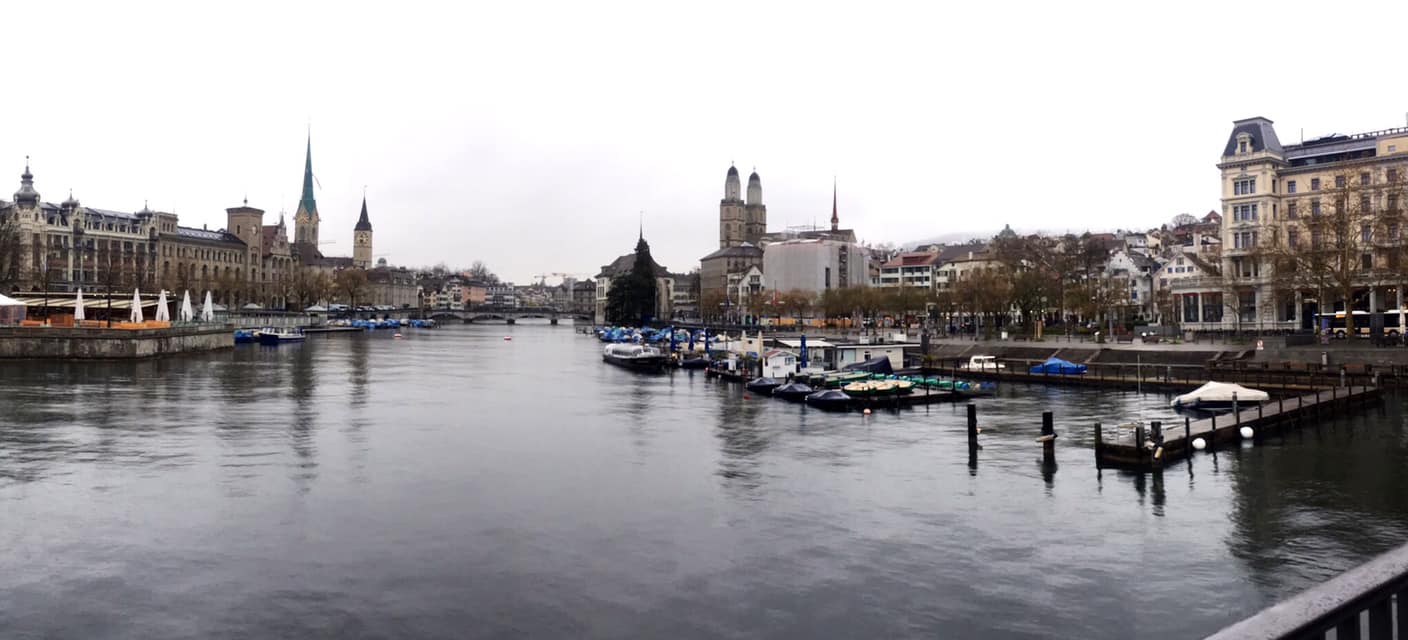
On our one ceaselessly wet day, we took a day trip to Zürich. After some sodden wandering, we were 'forced' to take refuge in the Sprüngli café. 


I could not have taken a trip to Lucerne without visiting the Richard Wagner Museum, based in Tribschen, the country house where he lived from 1866 to 1872. The signs to the museum are, shall we say, unmistakable.


"Unhand my wife, sir!"


It's easy to see why he found the location so inspiring. He wrote the 'Siegfried Idyll' (some of the manuscript is in my snap of the music below) and completed both 'Siegfried' and 'Meistersinger' while residing in Lucerne. The Museum also displayed early editions of his librettos and books - to its credit, there was no glossing over of his more repellent ideas. A copy of 'Judaism in Music' sits like a festering sore amid exhibits that help remind us that perhaps some of the most perfect operatic music ever composed came from so deeply imperfect an individual.


Yes, he turns up inside as well.


HIS ACTUAL PIANO!


Our last day involved returning to Zürich to catch the flight home. Just time to dodge the street parade (in impeccably Swiss fashion, there were pavement 'corridors' to help you get around through the hordes of spectators) and pay homage to the Opera House. I picked up a copy of the 19/20 season brochure. You never know...


Monday, 8 April 2019

East end girls: ENO's 'Women of Whitechapel' - and New Season alert

As the final work in English National Opera’s 2018/19 season broadly looking at the effects of ‘toxic masculinity’, this new opera by Iain Bell (composer) and Emma Jenkins (librettist) focuses on the lives the women Jack the Ripper murdered were leading, rather than their deaths. The aim is to animate them from being the mere prostitute-ciphers they risk becoming when any telling of the story places the unknown killer in the foreground.

The show’s creators are careful to state that they have presented an imagined scenario to achieve this: but their idea is plausible and dramatically sound, allowing for the way the Ripper claimed his ‘official’ five victims with relative ease and speed over a couple of months. All the women live and work from the same dosshouse.

As the opera opens, Polly Nichols arrives, her marriage over due to her drinking. At first she tries to steal from the others, angering Mary Kelly (already living there with her young daughter Magpie) - but she is soon accepted into the group. We’re also introduced to three fellow residents and future victims: Annie Chapman, Liz Stride and Catherine Eddowes.


As we learn more about the women’s personalities, events start to escalate around them - normally the result of men’s action or inaction. The Police Commissioner procures children from Maud (the fearsome dosshouse madam) and has set his sights on Magpie. The murders begin, as local copper Johnny Strong announces a vicious killing (a possible Ripper victim that the women agree to identify). Complicating matters further are Squibby, who loves Mary and wants to take her away from prostitution; a writer who turns up to slum it in the dosshouse and transform what he sees into reportage; and a photographer whose fetish work may set alarm bells ringing all too late...

This is not a ‘murder mystery’ - we don’t know whodunnit and to its credit, the opera doesn’t offer a specific theory. That said, as this is a new work that I hope will enter the repertoire, I don’t want to give away too many ‘spoilers’ about how neatly the plot strands intersect to bring the surviving characters to the opera’s climax. Jenkins’s libretto is expertly constricted so that as the murders continue and the fear increases, we find out more and more about the women and their inner lives.

But in terms of avoiding whodunnit clichés, it is crucial to mention the key decision not to show the Ripper at all. Instead, the victims are absorbed into dark shadow, sometimes through a crowd or behind some stage business, until they’ve disappeared from our view. This strips the Ripper of his notorious ‘persona’ and ensures we remember the ‘living’ versions of the women we saw.

And how alive they are! While the production employs some costume colour-coding shorthand which allows you to pinpoint all the women easily however dark the environment (I was reminded of the multiple Marnies in another recent ENO premiere), the cast make them into such vivid individuals that you feel you know and care about them in the short moments that each has ‘in the sun’.

It’s impossible to single anyone out, so I won’t. Janis Kelly’s Polly is wistful, almost coquettish; Marie McLaughlin the warm ‘mother hen’; Susan Bullock’s Liz amused, impulsive; Lesley Garrett’s Catherine slightly hyper, watchful, bold. Ruling the roost is Maud, a terrifyingly committed performance from Josephine Barstow as the madam who has long since decided that the cycle of degradation trapping her tenants is simply the inescapable way of the world.

These ‘Women of Whitechapel’ could as easily be the ‘Sisters of St Martin’s Lane’, as they comprise a luxury line-up of singers with long-standing relationships with ENO. Natalya Romaniw as Mary - out in front of this extraordinary ensemble - is an absolute powerhouse, dominating scenes where she needs to, but at the same time able to create intimacy in the Coliseum’s vast dimensions for when the character must yearn, mourn and finally face her fate.

Given that the resilience of women is one of the opera’s major themes, it’s entirely appropriate that it celebrates this glorious thread of magnificent female singers spanning generations at ENO (and that includes the Chorus - more of whom below). Iain Bell’s music serves the cast and concept remarkably. I was struck by how the range in dynamics meant that we could imagine the women in normal conversation, the orchestra providing the soundtrack, but then layers of sound would build and build, filling the Coliseum until I felt its walls might bulge outwards. (I liked that all the women are sopranos: it meant they could articulate terror at fever pitch, and gave them a vocal unity.)

It’s a rich score, full of effects (I felt several ‘lurches’ of terror in my stomach) which never lapses into sentiment or schlock. At the same time, Bell and Jenkins have enough old-school sensibility to give the women ‘arias’, having them soliloquise and put even more flesh on their characters, without slowing the pace. One particularly memorable section allows Susan B to bring a somewhat ‘refreshed’ Liz into the limelight, only for the scene to turn on a dime into a horrific, violent misunderstanding. (There's also a point near the end - for me, the opera's only slight misstep - where I felt Mary - a genuinely complex, thorny character - had been shaped into a kind of angelic symbol... when in fact the true source of any hope at the end is courtesy of a 'grace note' ending involving Magpie. However, Natalya R's singing is so heartfelt and affecting, she carries the day.)

As one would hope for when seeing a new opera at ENO, Bell and Jenkins make full, clever use of the Chorus - capitalising on their formidable acting/movement abilities as well as their mighty sound. For much of the action, the men and women are separate.

The women - fellow dosshouse residents - while not ‘singled out’ by costume like the soloists, are presented as distinct, expressive, stoic, determined, mobilised. On the other hand, the men are dressed in identically black garb, a pack hunting its prey, identities blurred; a sinister throng, almost personifying the ‘darkness’. All the men in the opera go unnamed, or have Dickensian-ironic epithets: the powerless Squibby (a passionate Alex Otterburn), the ineffectual Strong - a typically nuanced performance from Nicky Spence. Even those men that try to be good are tainted: Squibby’s love for Mary is unrequited so why won’t he leave her alone; how much of the writer’s motives are tied up with wanting to ride in on a white charger; why can’t Strong enforce the law?

We don’t need an actual flesh-and-blood Ripper onstage because all the men are complicit - they all created and perpetuate these conditions that enable the women to be slaughtered.

Powerful enough in two halves, when the whole Chorus comes together at moments of the greatest intensity, the effect is heartstopping. At the end of Act 1, my companion and I literally reeled out of the auditorium, speechless. It's all credit to this ingenious opera, though, that the women of Whitechapel no longer seem so silent.

*


While I'm here, please note that ENO has recently announced its 2019/20 season. Lots to get excited about here: the Orpheus myth provides the foundation for a mini-season, with operas on the same theme from Gluck, Offenbach, Glass and Birtwhistle. Some 'classics' are back: Bizet's 'Carmen', Puccini's 'Madam Butterfly' (with Natalya R in the title role), Mozart's 'Marriage of Figaro', and the company's much-loved version of Gilbert & Sullivan's 'Mikado'. I'm particularly looking forward to seeing new productions of Verdi's 'Luisa Miller' and Dvorak's 'Rusalka'.

I'll write more about the new season in due course - some amazing singers coming to the Coliseum (alongside the matchless Chorus) - but in the meantime, get in: here's a link to the new season page on the ENO website. Public booking opens 24 April.

Saturday, 30 March 2019

An ECM playlist

This post first appeared on Frances Wilson's excellent blog 'The Cross-Eyed Pianist'. For a variety of features that - alongside a special interest in all aspects of piano playing and listening - focus on wider classical music and cultural issues, please pay the site a visit here.

Late last year, I sent Frances a selection of music by artists on ECM Records. The label had only embraced streaming the year before - so curious listeners could explore its distinctive approach more easily (and cheaply!). 2019 sees ECM reach its 50th anniversary. As I'm currently in 'playlist mode' (see my previous post) - and about to go away on a short break - it seemed a good time to archive my ECM mix here. I hope you enjoy it.

*
We’re coming up to the first anniversary of a slightly unusual and unexpected musical event – or to be more accurate, ‘music business event’. On 17 November 2017, the record label ECM made virtually all of its catalogue available on streaming services for the first time.

For anyone unfamiliar, ECM is a Munich record label, founded almost 50 years ago – and still run – by producer extraordinaire Manfred Eicher. Initially the focus was on modern jazz music, but in the mid-eighties Eicher established the parallel ‘ECM New Series’ imprint to cover classical music.

It may be because the boss is a producer that ECM is famed for exceptional recording quality and detail. It’s tempting to think that the New Series seemed at once boldly contemporary (featuring composers linked to minimalism, like Arvo Pärt and Steve Reich) and wilfully archaeological (the exquisite early choral recordings of Trio Mediaeval or the Hilliard Ensemble), because these ‘extremes’ of classical music particularly benefited from such finely-wrought clarity.

This wide variety means that while there isn’t an ‘ECM sound’ as such, there’s definitely an ECM aesthetic. As well as making the records sound gorgeous, the label’s sleeve design – even into the CD era – has a largely abstract austerity that totally fits its musical output: enigmatic yet welcoming, arty, classy, attractive, open to wide interpretation.


This strong identity is arguably what kept ECM away from streaming platforms for as long as possible: the physical object, played on the best equipment you can muster, is part of their ideal. However, the fact that Eicher and co have now given in means you can at least explore a remarkable range of beautifully documented music at great leisure (and little or no cost) – hopefully on a ‘try before you buy’ basis, as a shelfful or so of ECM releases is a truly joyful sight.

Perhaps treating all of its artists with the same sonic respect, whatever the genre, is the engine behind another distinctive feature of ECM’s output: inspired collaborations. Eicher seems to delight in bringing musicians on the label from both jazz and classical camps together, resulting in highly rewarding joint releases, without compromising the spirit of their individual recordings.

This is a key theme in my very personal ECM playlist. There’s a run of three tracks where Norwegian saxophonist Jan Garbarek first plays with a group of Pakistani musicians, followed by a selection from his celebrated partnership with the Hilliard Ensemble – then we hear the Hilliards on their own performing a striking contemporary piece in contrast to their original ‘early music’ idiom.

Latterly, the Trio Mediaeval have recorded an album with trumpeter Arve Henriksen – a record that, while very different, seems to rejoice in a similar spirit, and a choice from this starts the whole playlist off. Bringing proceedings to a close is John Surman – another versatile saxophonist who can career from furious hard bop to drones/electronica and all points in between. However, his two albums with a string quartet are real jewels in ECM’s crown, as I hope ‘At Dusk’ proves.


Along the way, I’ve tried to bring in some of ECM’s most arresting characters. There’s Stephan Micus, who seems to learn and compose on a different array of instruments from all over the globe on each release, yet here foregrounds his own voice. Or Nik Bartsch, a Swiss pianist who describes his work as ‘ritual groove music’ (about four minutes into the playlist track, you’ll hear why). He records mainly with two bands, Ronin – who feature here – and Mobile, depending on the configuration of musicians the material needs. The distinctive, unhurried and wonderfully delicate piano of Marilyn Crispell, followed by the atmospheric vocalising from Susanne Abbuehl.

And much more… I could have carried on and on but thought I had better stop at 20 tracks (and 2 hours)! As you will find if you explore ECM further for yourself, I could have gone off at so many tangents: used Ralph Towner as a springboard to fellow guitarists John Abercrombie, Pat Metheny or Terje Ryphal; or followed Alexei Lubimov into the label’s roster of esteemed classical pianists (including Sir Andras Schiff). Keith Jarrett’s recordings alone must provide more than 100 hours of listening (some 90 recordings, including a few multi-disc sets).

I hope you enjoy this rather focused selection, then, and feel inspired to find ‘your ECM’ among the label’s near-limitless riches.


Sunday, 24 March 2019

Beat the clock

Following a brief period of relative quiet on the live cultural front, it felt like the time was right for a new playlist on the blog.

After de-stressing one evening recently by motoring through a load of pop songs on YouTube, I started to have flashbacks to my teenage and early working years, when doing a similar sort of thing might have meant sitting on the floor surrounded by piles of seven inch singles, or albums, or CDs - so that losing yourself in the music almost felt like a physical, as well as aural, experience.

Because, by definition, nostalgia is a modern activity, I think a lot of Today's Youth are as tuned in to how people my age (add the prefix 'middle') used to enjoy music as they want to be. Those who like a tactile channel for storing music are certainly helping the vinyl revival along. And even a term like 'mixtape' survives as a catch-all description for a lovingly-compiled playlist, even though the 'tape' bit no longer really features.

I used to set myself the task of compiling entire tapes of tracks where there was one rule: nothing longer than 3 minutes. Minimum boredom (and therefore, as little fast-forwarding as possible), maximum variety. I've resurrected that rule again here, but there's a bit more classical and jazz than there used to be in the melting pot.

I think it turned out to be a relatively gentle selection (with a few bursts of oomph and welly), but I hope you enjoy the rate of the changes. With 15 tracks in all, I hope it will strike a particular chord with any listeners immediately cheered by the phrase "fits on one side of a 90".

*

I've included versions taken from YouTube directly below - then at the end of the post there's a repeat of the playlist for Spotifiers.

Fleetwood Mac: 'Never Going Back Again'


Ralph Towner: 'Gloria's Step'


Talking Heads: 'Paper'


Sandrine Piau, Susan Manoff: 'C'est ainsi que tu es' (Poulenc)


Penguin Café Orchestra: 'Giles Farnaby's Dream'


Kate Bush: 'Army Dreamers'


Beirut: 'Corfu'


North Sea Radio Orchestra: 'He Wishes for the Cloths of Heaven'


Thelonius Monk: 'Well You Needn't'


Six Organs of Admittance, 'Lisboa'


Véronique Gens, Roger Vignoles: 'La flûte de Pan' (Debussy)


Cotton Mather: 'My Before and After'


Nigel North: 'Mrs Winter's Jump' (Dowland)


Oregon: 'The Silence of a Candle'


Dame Janet Baker, Gerald Moore: 'Corpus Christi Carol' (arr. Britten)


Sunday, 10 March 2019

Newsflash(backs)

A slightly different post today, with a celebratory tone. On occasion, especially lately, I think I've let my exasperation show on the blog about the day job eating up more and more time - so, while I'm still determined to see and hear as much music/art as I can, I can't write about it as quickly as I'd like, if at all. A classic 'first world problem', of course - I know how fortunate I am to be able to go to these events in the first place - but it still pains me when I feel I'm not getting the word out.

So allow me to wallow in a couple of occasions when I've already written about some music and performances which are now re-emerging into the spotlight - where my finger has briefly, if not quite touched the pulse, at least pointed at it fairly accurately as it hurried past!

Carolyn Sampson & Joseph Middleton's 'Reason in Madness'

A couple of Fridays ago, Mrs Specs and I took a gratuitous day off work to hear Carolyn Sampson and Joseph Middleton give a lunchtime recital at LSO St Luke's of selections from their beautiful 'Verlaine Songbook' CD. It was a reminder - were one needed - of CS's infallible purity of tone and emotional expression, gliding over JM's impossibly fleet, delicate accompaniment. Both concert and album are also a reminder of the duo's love of in-depth programming - what other recital would not only remind you of Debussy's famous 'Claire de lune' setting, but make the case that there are at least two others that might be even greater? Look out for the concert on BBC Radio 3 on 10 April (then on BBC Sounds afterwards, I'd hope) and, even better, buy the CD (more songs!).


But, in a way, I digress. Another exciting feature of the event was that the artists were signing advance copies of their new recording, 'Reason in Madness' - released this coming week. This was a particularly welcome development, as I'd been eagerly awaiting this disc after being utterly blown away by the Wigmore Hall concert they gave of this programme all the way back in July 2017. (You can read my write-up here.)

I don't want to give the impression that their CDs are 'routinely' brilliant, because there is evidently so much planning, forethought and care poured into every one. But 'Reason in Madness' the album is as fine a realisation of the gig as you could hope for. As with their previous discs, it's hard to imagine reaching the end of the year without this remaining as one of my top releases.

The songs chart not just the poignancy and frequency of female madness in literature but also the cumulatively unsettling fascination of male poets and composers with the subject - in one case, the poet Pierre Louÿs actually claiming his Bilitis verses, set by Debussy, were written by a contemporary of Sappho. The concert version played out in two halves around the interval - German and French - each building in atmosphere and intensity in quite different ways. On the CD, they have carefully adjusted the sequence to work as a single listen: 'sets' of songs are preserved (for example, a trio of 'spinning' tales, Ophelia lieder from Strauss and Brahms, Wolf's Mignon Lieder), but the German and French treatments now dovetail each other, sustaining the mood throughout, and emphasising the pervasiveness of the theme - almost as insidious as madness itself.


At the end, and rightly so, is the near-operatic showstopper 'La Dame de Monte-Carlo' by Poulenc. The heartrending, characterful gear-shifts here (combined with the memory of CS's recent haunting portrayal of Debussy's Mélisande for Scottish Opera) make me hopeful that this pair will one day tackle the voice/piano version of Poulenc's 'La voix humaine'. Putting in my official request now!

Keep an eye on the BIS Records website to buy 'Reason in Madness' on release.

English National Opera recognised by the Olivier Awards

As regular readers will know (thank you, darlings, thank you), I'm a fairly vocal supporter of English National Opera. Historic trauma behind the scenes (well-documented and, one hopes, increasingly a thing of the past) has resulted, I believe, in ENO negotiating choppier waters in the public eye than certainly the performing ensemble deserve. But whatever the various pressures they've been under, the resident company have never let me down: from the luxurious versatility of the Orchestra to the truly outstanding Chorus - a group of fiercely talented actor-singers (reliably taking on solo parts when required), who are always able to deliver that spine-tingling wall of sound, while convincing you that you're watching an array of individuals who somehow work in sync, constantly aware of each other. They are the reason that ENO Studio Live - a Chorus-driven enterprise that takes smaller productions out of the Coliseum into more intimate venues - has been such a great success: they can clearly 'headline' and shoulder a show in their own right, bringing the audience close enough to hear their separate voices and see just what they're capable of.

How brilliant, then, to read that four ENO productions have been highlighted in this year's Olivier Award nominations. One of them, I confess, I didn't manage to see: the collaboration with Regent's Park Open Air Theatre on Britten's 'The Turn of the Screw', which has been nominated for Best New Opera Production. It's up against a couple of strong contenders (both Royal Opera House - 'Katya Kabanova' and the terrifying 'Lessons in Love and Violence') - best of luck to them all.

The other three nominations are for Outstanding Achievement in Opera...

  • David Butt Philip and Roderick Williams in 'War Requiem'
  • The ENO Chorus for 'Paul Bunyan'
  • The specially-created Ensemble for 'Porgy and Bess'
Thoughtlessly gatecrashing the nominations without having anything to do with ENO is Andris Nelsons, for his conducting of ROH's 'Lohengrin'. Even if AN's great work brings him eventual victory (though I shall have to write an indignant 'Nelsons column' if he does!) … this is such a great reflection of how ENO has been firing on all cylinders in recent months - and hopefully into the future, too.

You won't be at all surprised at my hope that 'Paul Bunyan' gets the nod, despite my admiration for the other nominees. I'm a little disappointed that the 'War Requiem' nomination didn't include Emma Bell (the piece gives prominence to three soloists), or for that matter the combined vocal forces (which included the regular ENO Chorus, the 'Porgy and Bess' ensemble and Finchley Children's Music Group, all acting from memory a piece normally performed with score as a static work.

But 'Paul Bunyan' - with ENO's Chorus and cohorts taking over Wilton's Music Hall, bending and shaping it into an idiosyncratic opera grotto, was such a consummate achievement for all concerned, combining the volume and command of operatic voices with a guerrilla-revue sensibility and the immediacy and intimacy of a club gig. No-one who saw it will forget it, and it's already earned its first revival, this time at Alexandra Palace Theatre. (I've booked.)

ENO always inspire me to write, so you can refer back to some of my old posts for more info. My reaction to 'Paul Bunyan' is here - which I hope might prompt you to book a seat for the revival. I also did a part-season round-up which included 'Porgy and Bess' and 'War Requiem' - here.