Readers with excellent memories and above-average loyalty may remember that one of my best-loved and most-played discs of last year was 'Fleurs', the debut recital album by soprano Carolyn Sampson and pianist Joseph Middleton. It has since nestled itself comfortably amid my all-time favourites.
I was so excited about their follow-up recording, 'A Verlaine Songbook', that in the few weeks ahead of its release date, I actually felt like it would never come out. It reminded me so much of waiting for new albums from the bands and artists I idolised in my youth, and it felt good that this time it was classical music inspiring a healthy dose of unchecked enthusiasm, not to mention anguished impatience.
Now it's arrived, I'm overjoyed to report that it's stunning. Obviously, I haven't lived with 'A Verlaine Songbook' for as long, but early signs are that the new disc is every bit its predecessor's equal, if not even better. I know! Better than 'Fleurs'! Imagine!
Reassuringly, 'Verlaine' was recorded in the same place, with the same instrument, a Steinway D. So the acoustic - which they utterly nailed on 'Fleurs' - is as pristine, and as familiar. While I'm aware that very few recital partners exist in a bubble - they all regularly sing and play with other musicians and ensembles - I'm finding it hard to think of any duo that better capture their particular rapport on disc than CS and JM. Both find beauty in precision, and JM's high notes dance cleanly around CS's vocal - neither could 'drag' a phrase if they tried. However, the sound is so pin-sharp that even in the split-seconds between note-making, we hear the occasional pedal stroke, or lightning intake of breath - and the result is an encompassing intimacy, a genuine 'you're in the room' feel. What's the opposite of airless? Airful? It's warm, real.
As the name rather gives away, all the songs are settings of Verlaine texts - so this intimate atmosphere establishes the perfect mood for an entire set of 'mélodies'. At a hugely generous 80 minutes (which I think is still more or less the maximum amount of music a CD will take), it's possible to become almost intoxicated at times, to drown pleasurably in the waves and ripples courtesy of Debussy, Fauré and a host of fellow composers. (CS and JM are master programmers, by the way, as 'Fleurs' fans will already know.)
It's a pleasure to see some complete sets of songs find their way onto the album. These include Fauré's 'La Bonne Chanson' - the last two settings in particular ('N'est-ce pas?' and 'L'hiver a cessé') require superb transitions of mood from the pair: JM darts across the keyboard with dizzying velocity before 'bringing it back home' with bluesy closure, as CS negotiates the shift down in gear with subtly effective adjustments to volume and tone, allowing some syllables to fade away, suggesting a closer audience than in a concert hall. (It really brings home the thought that melodiés are, after all, chansons' posh cousins.)
Debussy's 'Ariettes oubliés' form the (near) climax to the album, and again for me the highlights are two songs mid-cycle. 'Chevaux de bois' seems to involve JM playing more notes at once than he has fingers, or possibly than there are keys on the piano - but a song like this is also a perfect vehicle for CS, whose ability to sing at such exhilarating speed (perhaps baroque-fuelled) with no loss of character or volume more than matches the power accompaniment and in fact rides it to greater heights. After this comes the astonishing 'Green', its nudging piano riff punctuating what I think must be the most sensual performance from CS I've ever heard. Initially, the tempo changes accentuate the voice's gentle pleading, while the second verse carefully steers her towards the tour de force of the final minute: as the lovers in the song relax post-passion, the high note on 'baisers' ('kisses') simply stops. Then, she sings almost conversationally, as if leaning into the listener's ear alone - with all the feeling, expression, and placing of the note still present, she becomes gradually softer, more delicate, as the accompaniment resolves around her.
It's one of those apparently small, but in fact crucial points in a performance that make you realise you're listening to people who really are brilliant: the kind of decision that makes a rendition truly great. 'Green' is a beautiful song, but this version stopped me dead in my tracks - it's that good. It makes me desperate to hear the duo tackle a complete 'Proses lyriques' (they tantalised with just the one on 'Fleurs').
'A Verlaine Songbook' also deserves praise for unearthing some of its perhaps more buried treasure. There's a wholly positive Polish influence. Marvellous to hear female composer Poldowski (Belgian, with a Polish dad) championed with five songs, all distinctive in their elements of playfulness and passion, and perhaps understandably (without wishing to second-guess or over-simplify), they seem to bring out an especially sympathetic response from the soprano. And one of my personal favourites on the record is Szulc's setting of 'Clair de lune', as its glorious descending piano figure in the intro shape-shifts beneath CS's gliding vocal (an audio encapsulation of the still light caressing the rippling water) before returning at the close.
I could go on: there's so much to enjoy - from the bass rumble the JM touch conjures up during the Debussy 'Clair de lune' to the unhurried, seemingly effortless elegance of CS's performance of the classic Hahn setting of 'L'heure exquise'.
I can't recommend it highly enough. Buy it. Or ask Santa, but for pity's sake, do something. Now I need to return to being excited about what the pair of them will come up with next...
Friday, 9 December 2016
Sunday, 27 November 2016
Muse company: 'Les Contes d'Hoffmann' at the ROH
Throughout Offenbach's 'Les Contes d'Hoffmann' ('The Tales of Hoffmann') at the Royal Opera House, the word 'luxury' kept popping into my head: luxurious sets, a luxurious running time, certainly a luxury cast - plus a score and libretto to luxuriate in, full of ideas and inventiveness.
A 'quick' run-down of the plot, then. Hoffmann is a poet, succumbing to alcoholism. (And he was, in fact, a real person: E.T.A. Hoffmann, on whose stories the opera is loosely based.) His Muse takes the guise of Hoffmann's loyal companion, Nicklausse, and plans to have Hoffmann commit himself once and for all to words alone. In theory, this shouldn't be too difficult, because Hoffmann has had possibly the most disastrous love life of any chap, real or fictional, in recorded history. The opening prologue - set in Hoffmann's and his drinking pals' pub of choice - sets us up for his latest potential failure.
We learn that Hoffmann - yet to show up at the inn - is due to meet the diva Stella after she finishes that evening's performance. However, a sinister councillor called Lindorf arrives first, scheming to intercept the assignation and steal Stella away from under Hoffmann's nose. When Hoffmann finally arrives, already somewhat 'lit up', he recognises Lindorf as someone who keeps turning up when things are about to go badly wrong. This jolt leads him to recount the sad stories of the previous three loves of his life.
(All production photos copyright Royal Opera House, taken by Catherine Ashmore.)
And so the opera 'proper' plays out in flashback. Acts 1, 2 and 3 are, in effect, a kind of 'Trittico': they are almost stand-alone as short works in themselves, and each has its own distinct style/genre. Over the years, directors have changed the running order, depending on what they feel works best - it has no real impact on the overarching story. However, the links between the three Tales are what gives the whole its cumulative power. Hoffmann as doomed lover, along with the faithful Nicklausse, are the two recurring characters - although not necessarily the only familiar faces....
In the ROH production, we first get the 'Olympia' act, which is a farce of sorts. Hoffmann is smitten with the 'daughter' of Spalanzani, a scientist with a special interest in automatons. Olympia is to 'come out' at a huge party thrown by her dad. Nicklausse knows that the debutante is in fact a robot, but his warnings to Hoffmann fall on deaf ears. The doll is so convincing that Hoffmann believes she returns his affections. Sadly, Coppélius - a fellow scientist who gave Olympia her deceptively lifelike eyes - is conned out of payment by Spalanzani, and bursts back on the scene to tear the automaton apart. Hoffmann only then realises he was in love with a machine.
The 'Giulietta' act, set in Venice, is more along the lines of decadent horror. Under the influence of the sinister collector of souls Dapertutto, the courtesan Giulietta agrees to bring him Hoffmann's reflection. Schlemil, a former lover of Giulietta who surrendered his shadow to her, challenges Hoffmann to a duel, but the poet kills him. Nicklausse starts to engineer an escape from the city, but not before Giulietta secures Hoffmann's reflection and abandons him to glide away on a gondola with the magician.
Finally. we have heartbreak and tragedy in the 'Antonia' Tale. Antonia suffers from a mystery illness and her dad, Crespel, is vexed on two fronts: the over-attentive (and rather non-medically named) Dr Miracle, who was also in attendance at the early death of Antonia's mother and may do Antonia more harm than good... and secondly, Hoffmann, who loves to encourage Antonia to sing, which leaves her exhausted.
Crespel takes Antonia away, but Hoffmann and Miracle both track them down. Hoffmann, arriving first, learns about Antonia's condition - so suggests they marry but that Antonia should give up singing completely. However, he then leaves: Miracle enters, conjures up the dead mother's spirit, persuades Antonia to sing her heart out .... and so she dies, leaving Crespel bereft and Hoffmann alone for the third time.
We return to the inn for an epilogue. Lindorf, with an absolute minimum of fuss, distracts and escorts away Stella with ease. However, Nicklausse transforms himself back into the Muse, and persuades Hoffmann that he will channel his anguish into great works.
While it's possible to cast certain groups of roles across the three main acts to single singers (conventions seem to vary), for one it is vital: the bass-baritone who sings Lindorf also re-appears as Coppélius, Dapertutto and Miracle, so that Hoffmann recognises the same embodiment of villainy, taking his loved ones away from him each time.
Phew! Three operas in one. And I must admit, I really responded to this version in this order: the first story - despite Hoffmann's inevitable romantic disappointment - is laugh-out-loud funny in parts; and then the mood progressively darkens: while Hoffmann has sincere feelings for Giulietta, we already know that she is compromised and the ghoulish nature of the villainy still keeps the romance at something of a distance. Not so in the 'Antonia' sequence - the lovers are clearly in sync here, and their helplessness in the face of the fate we know they can't avoid is truly agonising (despite the bizarre comic interlude courtesy of deaf servant Frantz, which possibly adds to the tension by delaying proceedings). Offenbach's masterful score is our relentless guide through these mood changes - the jovial musical gags of the prologue (Hoffmann's party piece about the dwarf Kleinzach) and first act (Olympia's Doll Song, where she slows down several times and has to be 'wound up' again to keep going) little preparing us for the oncoming storms.
As befits an opera that makes a working assembly from a huge number of moving parts, the superb cast sang and acted with such an ensemble spirit that it's very difficult to single out favourites. I was very intrigued to see how Vittorio Grigolo would tackle Hoffmann, after experiencing his exuberance in 'L'elisir d'amore', followed by an admirably restrained turn in 'Werther'. Here he combines the two personas, with his youthful naivety in the Olympia act - playing the moment where Hoffmann reads undying affection in the robot's non-committal 'Oui' for maximum comic effect - giving way to the wracked torment of the later sections. Thomas Hampson - master of disguise - was in intimidating voice as Lindorf and co, making each incarnation vocally distinct: Lindorf's cool reserve contrasted with the inventor's blustering rage, sorcerer's aloof power and doctor's Satanic persistence: I had to listen, as well as look, twice to assure myself it was the same man: brilliant.
The lovers each have an act's worth of opportunity to make an impression - and they all seized it. Sofia Fomina was a startling Olympia, singing beautifully but, of course, with a necessary air of even rigidity, giving the automaton just enough 'life' to see how Hoffmann might've been fooled. Her movement was genuinely jaw-dropping: not just the obvious comic highpoints where she runs out of steam and needs 're-booting', but when she was fully up and running. The regularity of her gestures - in particular some business with a fan that she brought across herself in exactly the same way, to exactly the same notes - was sublime. Christine Rice as Giulietta had perhaps the hardest job to do dramatically, as someone already held sway by the evil magician, but gave an alluring, enigmatic performance that still managed to shock with her betrayal. Sonya Yoncheva was utterly heart-rending - a perfectly-judged characterisation that gave Antonia's voice beauty and fragility, fatal when its latent power is unleashed. I remember wondering at SY's versatility, having seen her only weeks before debuting a commanding and resolute Norma, also here at the ROH.
But I actually think, if pressed, I would give my laurel to the Muse herself, Kate Lindsey. Carrying off the 'trouser' role of Nicklausse with convincingly masculine gung-ho is only part of the story: the layering of his character gives the opera some of its finest moments. Nicklausse is generally the thinker of the pair, and one suspects Hoffmann could barely cross the road unaided without him: KL does a superb job of steering clear of any over-zealous thigh-slapping and grounds the boy with the stability the role needs. This is brought to fruition when his/her transformation back into the Muse - a real visual coup - is surprising and stunning, yet the stateliness has not come from nowhere. (For all that, KL delights the audience with Nicklausss's impersonation of Olympia - on the night I went, there was spontaneous applause, richly deserved.)
There's much food for thought in the production, too - originally by the late John Schlesinger (best known for directing films like 'Darling', 'Midnight Cowboy' and 'Marathon Man'). Two staircases dominate the stage, as we first see the two-level tavern, with a cubby-hole to the left - Lindorf settles himself into this snug as the Tales begin. Each subsequent act, however, conforms to this pattern, even though the action takes place all over the shop. Spalanzani's great house has its guests swarm around the stairs to gawp at Olympia; the upper level becomes a Venetian bridge with steps down to the courtyard for the second act; while we are back inside for Crespel's house in Antonia's story. In each act, the evil seems focused around stage left (sinister?), in particular the seductress's bed and - quite literally - the hellish furnace which appears to be home to Dr Miracle.
In the same way that the three stories combine to form the whole, we're explicitly told (by Nicklausse) that the three lovers are all aspects of Stella: youthful beauty, sex appeal and musical talent. I don't think this quite moves the opera into 'It's all in his head' territory - Hoffmann is genuinely battered and aggrieved by his experiences - but the consistent shape of the staging reminds us that we never actually leave the inn: these are stories being spun, and Lindorf's malevolent presence is always there, listening on the left, and the Tales are being overlaid, like tracing paper, onto the same template below.
Given that the resolution is Hoffmann finally deciding not to fight against his Muse, it is tempting to see Lindorf as the personification of Hoffmann's own demons. I found it interesting that Hoffmann is in fact responsible for his own misfortune throughout: he refuses to see the truth staring him in the face in 'Olympia' (if the doll wasn't destroyed then, he would've found out in unthinkably embarrassing ways later on); he kills his rival in the duel in Venice without any actual interference from Dapertutto; and he puts Antonia in a state of emotional confusion after encouraging her to sing, then insisting she doesn't - again, if you remove Miracle from the story, it is still likely that Antonia would've sung again and died from exhaustion. Hoffmann seems to have conjured up Lindorf as a kind of symbol or catalyst who represents, but doesn't cause, the trauma. When he decides his Muse is the true love of his life - a happy ending, so to speak - he is as dismissive of Stella as he is of Lindorf, and the two simply leave without ceremony.
Different possibilities for interpretation aside, the production is full of incidental pleasures to thrill and amuse. I particularly enjoyed the notion that all of Spalanzani's servants are prototype automatons, none of whom functions quite as well as Olympia; the simple sleight-of-hand involved with showing Hoffmann a mirror without his reflection; and the manner of Antonia's mother 'coming to life'. This kind of loving attention to detail, alongside the total commitment of the singers and players, gave the impression of an entire company as devoted to the Muse as Hoffmann himself.
A 'quick' run-down of the plot, then. Hoffmann is a poet, succumbing to alcoholism. (And he was, in fact, a real person: E.T.A. Hoffmann, on whose stories the opera is loosely based.) His Muse takes the guise of Hoffmann's loyal companion, Nicklausse, and plans to have Hoffmann commit himself once and for all to words alone. In theory, this shouldn't be too difficult, because Hoffmann has had possibly the most disastrous love life of any chap, real or fictional, in recorded history. The opening prologue - set in Hoffmann's and his drinking pals' pub of choice - sets us up for his latest potential failure.
We learn that Hoffmann - yet to show up at the inn - is due to meet the diva Stella after she finishes that evening's performance. However, a sinister councillor called Lindorf arrives first, scheming to intercept the assignation and steal Stella away from under Hoffmann's nose. When Hoffmann finally arrives, already somewhat 'lit up', he recognises Lindorf as someone who keeps turning up when things are about to go badly wrong. This jolt leads him to recount the sad stories of the previous three loves of his life.
(All production photos copyright Royal Opera House, taken by Catherine Ashmore.)
And so the opera 'proper' plays out in flashback. Acts 1, 2 and 3 are, in effect, a kind of 'Trittico': they are almost stand-alone as short works in themselves, and each has its own distinct style/genre. Over the years, directors have changed the running order, depending on what they feel works best - it has no real impact on the overarching story. However, the links between the three Tales are what gives the whole its cumulative power. Hoffmann as doomed lover, along with the faithful Nicklausse, are the two recurring characters - although not necessarily the only familiar faces....
In the ROH production, we first get the 'Olympia' act, which is a farce of sorts. Hoffmann is smitten with the 'daughter' of Spalanzani, a scientist with a special interest in automatons. Olympia is to 'come out' at a huge party thrown by her dad. Nicklausse knows that the debutante is in fact a robot, but his warnings to Hoffmann fall on deaf ears. The doll is so convincing that Hoffmann believes she returns his affections. Sadly, Coppélius - a fellow scientist who gave Olympia her deceptively lifelike eyes - is conned out of payment by Spalanzani, and bursts back on the scene to tear the automaton apart. Hoffmann only then realises he was in love with a machine.
The 'Giulietta' act, set in Venice, is more along the lines of decadent horror. Under the influence of the sinister collector of souls Dapertutto, the courtesan Giulietta agrees to bring him Hoffmann's reflection. Schlemil, a former lover of Giulietta who surrendered his shadow to her, challenges Hoffmann to a duel, but the poet kills him. Nicklausse starts to engineer an escape from the city, but not before Giulietta secures Hoffmann's reflection and abandons him to glide away on a gondola with the magician.
Finally. we have heartbreak and tragedy in the 'Antonia' Tale. Antonia suffers from a mystery illness and her dad, Crespel, is vexed on two fronts: the over-attentive (and rather non-medically named) Dr Miracle, who was also in attendance at the early death of Antonia's mother and may do Antonia more harm than good... and secondly, Hoffmann, who loves to encourage Antonia to sing, which leaves her exhausted.
Crespel takes Antonia away, but Hoffmann and Miracle both track them down. Hoffmann, arriving first, learns about Antonia's condition - so suggests they marry but that Antonia should give up singing completely. However, he then leaves: Miracle enters, conjures up the dead mother's spirit, persuades Antonia to sing her heart out .... and so she dies, leaving Crespel bereft and Hoffmann alone for the third time.
We return to the inn for an epilogue. Lindorf, with an absolute minimum of fuss, distracts and escorts away Stella with ease. However, Nicklausse transforms himself back into the Muse, and persuades Hoffmann that he will channel his anguish into great works.
While it's possible to cast certain groups of roles across the three main acts to single singers (conventions seem to vary), for one it is vital: the bass-baritone who sings Lindorf also re-appears as Coppélius, Dapertutto and Miracle, so that Hoffmann recognises the same embodiment of villainy, taking his loved ones away from him each time.
Phew! Three operas in one. And I must admit, I really responded to this version in this order: the first story - despite Hoffmann's inevitable romantic disappointment - is laugh-out-loud funny in parts; and then the mood progressively darkens: while Hoffmann has sincere feelings for Giulietta, we already know that she is compromised and the ghoulish nature of the villainy still keeps the romance at something of a distance. Not so in the 'Antonia' sequence - the lovers are clearly in sync here, and their helplessness in the face of the fate we know they can't avoid is truly agonising (despite the bizarre comic interlude courtesy of deaf servant Frantz, which possibly adds to the tension by delaying proceedings). Offenbach's masterful score is our relentless guide through these mood changes - the jovial musical gags of the prologue (Hoffmann's party piece about the dwarf Kleinzach) and first act (Olympia's Doll Song, where she slows down several times and has to be 'wound up' again to keep going) little preparing us for the oncoming storms.
As befits an opera that makes a working assembly from a huge number of moving parts, the superb cast sang and acted with such an ensemble spirit that it's very difficult to single out favourites. I was very intrigued to see how Vittorio Grigolo would tackle Hoffmann, after experiencing his exuberance in 'L'elisir d'amore', followed by an admirably restrained turn in 'Werther'. Here he combines the two personas, with his youthful naivety in the Olympia act - playing the moment where Hoffmann reads undying affection in the robot's non-committal 'Oui' for maximum comic effect - giving way to the wracked torment of the later sections. Thomas Hampson - master of disguise - was in intimidating voice as Lindorf and co, making each incarnation vocally distinct: Lindorf's cool reserve contrasted with the inventor's blustering rage, sorcerer's aloof power and doctor's Satanic persistence: I had to listen, as well as look, twice to assure myself it was the same man: brilliant.
The lovers each have an act's worth of opportunity to make an impression - and they all seized it. Sofia Fomina was a startling Olympia, singing beautifully but, of course, with a necessary air of even rigidity, giving the automaton just enough 'life' to see how Hoffmann might've been fooled. Her movement was genuinely jaw-dropping: not just the obvious comic highpoints where she runs out of steam and needs 're-booting', but when she was fully up and running. The regularity of her gestures - in particular some business with a fan that she brought across herself in exactly the same way, to exactly the same notes - was sublime. Christine Rice as Giulietta had perhaps the hardest job to do dramatically, as someone already held sway by the evil magician, but gave an alluring, enigmatic performance that still managed to shock with her betrayal. Sonya Yoncheva was utterly heart-rending - a perfectly-judged characterisation that gave Antonia's voice beauty and fragility, fatal when its latent power is unleashed. I remember wondering at SY's versatility, having seen her only weeks before debuting a commanding and resolute Norma, also here at the ROH.
But I actually think, if pressed, I would give my laurel to the Muse herself, Kate Lindsey. Carrying off the 'trouser' role of Nicklausse with convincingly masculine gung-ho is only part of the story: the layering of his character gives the opera some of its finest moments. Nicklausse is generally the thinker of the pair, and one suspects Hoffmann could barely cross the road unaided without him: KL does a superb job of steering clear of any over-zealous thigh-slapping and grounds the boy with the stability the role needs. This is brought to fruition when his/her transformation back into the Muse - a real visual coup - is surprising and stunning, yet the stateliness has not come from nowhere. (For all that, KL delights the audience with Nicklausss's impersonation of Olympia - on the night I went, there was spontaneous applause, richly deserved.)
There's much food for thought in the production, too - originally by the late John Schlesinger (best known for directing films like 'Darling', 'Midnight Cowboy' and 'Marathon Man'). Two staircases dominate the stage, as we first see the two-level tavern, with a cubby-hole to the left - Lindorf settles himself into this snug as the Tales begin. Each subsequent act, however, conforms to this pattern, even though the action takes place all over the shop. Spalanzani's great house has its guests swarm around the stairs to gawp at Olympia; the upper level becomes a Venetian bridge with steps down to the courtyard for the second act; while we are back inside for Crespel's house in Antonia's story. In each act, the evil seems focused around stage left (sinister?), in particular the seductress's bed and - quite literally - the hellish furnace which appears to be home to Dr Miracle.
In the same way that the three stories combine to form the whole, we're explicitly told (by Nicklausse) that the three lovers are all aspects of Stella: youthful beauty, sex appeal and musical talent. I don't think this quite moves the opera into 'It's all in his head' territory - Hoffmann is genuinely battered and aggrieved by his experiences - but the consistent shape of the staging reminds us that we never actually leave the inn: these are stories being spun, and Lindorf's malevolent presence is always there, listening on the left, and the Tales are being overlaid, like tracing paper, onto the same template below.
Given that the resolution is Hoffmann finally deciding not to fight against his Muse, it is tempting to see Lindorf as the personification of Hoffmann's own demons. I found it interesting that Hoffmann is in fact responsible for his own misfortune throughout: he refuses to see the truth staring him in the face in 'Olympia' (if the doll wasn't destroyed then, he would've found out in unthinkably embarrassing ways later on); he kills his rival in the duel in Venice without any actual interference from Dapertutto; and he puts Antonia in a state of emotional confusion after encouraging her to sing, then insisting she doesn't - again, if you remove Miracle from the story, it is still likely that Antonia would've sung again and died from exhaustion. Hoffmann seems to have conjured up Lindorf as a kind of symbol or catalyst who represents, but doesn't cause, the trauma. When he decides his Muse is the true love of his life - a happy ending, so to speak - he is as dismissive of Stella as he is of Lindorf, and the two simply leave without ceremony.
Different possibilities for interpretation aside, the production is full of incidental pleasures to thrill and amuse. I particularly enjoyed the notion that all of Spalanzani's servants are prototype automatons, none of whom functions quite as well as Olympia; the simple sleight-of-hand involved with showing Hoffmann a mirror without his reflection; and the manner of Antonia's mother 'coming to life'. This kind of loving attention to detail, alongside the total commitment of the singers and players, gave the impression of an entire company as devoted to the Muse as Hoffmann himself.
Sunday, 20 November 2016
Single minded: the Disappointment Choir
A relatively short, sharp post this time - as the message is a sincere, but simple one.
I've written a few times in the past about the Disappointment Choir, a band made up of two friends of mine, Rob and Katy. It's always a pleasure to post their material here, because luckily, I think the music they make is barnstormingly brilliant: I've never had to think twice about the pair feeling I might be 'just saying that'... nor my readers here suspecting I'm dutifully being nice about my mates. The records are too good.
Here is the DC's new single, 'Winter Hill'. A seasonal song of sorts, it carries exactly the right tone of warm melancholy - like an audio version of bright sun on a clear, freezing day:
This new release has all the hallmarks of the band's dynamic that I particularly love. They each have superb voices, but - unlike a 'classic' harmony duo, say - they don't really 'blend'. Instead - which is not quite the same thing - they just sound great singing at the same time. When the second verse kicks in, there's a definite moment of euphoria as the two different vocal styles 'snap' together. And as so often, Rob builds the sonic foundations - keyboards, basslines, electronics - for Katy to slice through, here with her trusty acoustic guitar and angelic backing chorus.
It's a gorgeous track - one of their finest achievements to date. If you like it as much as I do, please consider buying it. Festively, the DC are giving any proceeds to Young Minds, a major UK charity working for children's and young people's mental health. Here is the Bandcamp link: your purchase gets you 'Winter Hill' instantly, with a couple more tracks to follow on official release day, 2 December.
These may be people who shamelessly take their clothes - well, socks - off in their video to get your attention: but please support them all the same. Not all worthy causes get to benefit from such a fine song, so carefully and joyously performed.
I've written a few times in the past about the Disappointment Choir, a band made up of two friends of mine, Rob and Katy. It's always a pleasure to post their material here, because luckily, I think the music they make is barnstormingly brilliant: I've never had to think twice about the pair feeling I might be 'just saying that'... nor my readers here suspecting I'm dutifully being nice about my mates. The records are too good.
Here is the DC's new single, 'Winter Hill'. A seasonal song of sorts, it carries exactly the right tone of warm melancholy - like an audio version of bright sun on a clear, freezing day:
This new release has all the hallmarks of the band's dynamic that I particularly love. They each have superb voices, but - unlike a 'classic' harmony duo, say - they don't really 'blend'. Instead - which is not quite the same thing - they just sound great singing at the same time. When the second verse kicks in, there's a definite moment of euphoria as the two different vocal styles 'snap' together. And as so often, Rob builds the sonic foundations - keyboards, basslines, electronics - for Katy to slice through, here with her trusty acoustic guitar and angelic backing chorus.
It's a gorgeous track - one of their finest achievements to date. If you like it as much as I do, please consider buying it. Festively, the DC are giving any proceeds to Young Minds, a major UK charity working for children's and young people's mental health. Here is the Bandcamp link: your purchase gets you 'Winter Hill' instantly, with a couple more tracks to follow on official release day, 2 December.
These may be people who shamelessly take their clothes - well, socks - off in their video to get your attention: but please support them all the same. Not all worthy causes get to benefit from such a fine song, so carefully and joyously performed.
Sunday, 13 November 2016
ENOverview
Hello again. I hadn't meant to let quite this long go by without a blog post, but there it is. Life got in the way. Some bits of rubbishy, stressful stuff that I shouldn't in all honesty complain about - and also, on the plus side, a flurry of musical outings at a seemingly relentless pace - with no room in between to actually write about any of them!
So, now the work starts to try and rectify this to some extent - and it seems fitting to turn first to a company I never tire of writing about: English National Opera (ENO). With the new season now up and running, I have three of their recent productions still fresh in my memory: 'Don Giovanni', 'Tosca' and 'The Pearl Fishers'.
The new production of 'Don Giovanni', directed by Richard Jones, was electrifying. Bled of his hallmark bright colours, this time the doors, streets and windows were grey and grimy, as we moved from interiors to exteriors guided only by streetlamps and shadows. With great comic reversal, the conventions of a humorous genre - bedroom farce - were satirised to expose Giovanni's actions as truly despicable. To the overture, we saw a parade of women entranced, then escorted behind a closed door, by our anti-hero: richly funny at first, then relentless, emotionless as the conquest count increased.
Christopher Purves gave a totally commanding performance as DG - bullish charisma and utter confidence making his domination of his victims totally believable. He and Clive Bayley as servant Leporello made an excellent double act: in full-strength nerd costume (dark specs, unnaturally loud wig), the lackey seems to symbolise the asexual, admin-focused balance to DG's all-instinct, lust-driven existence. In the production's most jaw-dropping visual gag - so audacious it counts as a fully-fledged twist - we're given cause to wonder about the pair's relationship and who might be indispensable to who.
I daren't give away that particular coup away, in case the production is revived (it certainly should be). But there's plenty of other stuff to rave about. This version of the story is not afraid to go beyond 'sexy' into 'sordid' - from the opening seduction, we're in a world of prostitution, dark fantasy, safe words and submission. And it completely follows through: DG's pursuit of Zerlina (Mary Bevan, brilliantly bewitched and bewildered) on her wedding day takes place against a grubby, shambolic excuse for a party... where the (as ever) brilliant chorus perform masked dances, trapped in their own hidden identities, quite alone, tripping.
The whole cast offered complex, rich characterisations that - contradictory as it sounds - made them all stand out. Caitlin Lynch was a powerful Donna Anna, clearly headed for marital tedium with Don Ottavio - a superb incarnation by Allan Clayton, who sounded and acted utterly impassioned but never quite high-octane enough to satisfy his thrill-seeking fiancée. By contrast, Christine Rice as the unravelling Donna Elvira underpinned the piece with the necessary emotion, the anguished outcome of DG's wanton excesses. A special mention too for Danielle Meehan in a silent acting role, succumbing to the Don's charms by phone in another of the staging's queasily comic visual triumphs.
(And no surprise whatsoever that the orchestra packed a punch, with Mark Wigglesworth - their former music director - at the helm.)
'Tosca' offered a different kind of pleasure. In some ways, going to see 'Tosca' (or popping in a DVD of same) is a bit like going to see your favourite band: familiar enough to me now that I anticipate the twists and turns and recognise every vocal nook and cranny. But a little bit different each time, too - still capable of surprises, still giving you exactly what you want. From my perspective, I want a thrill-ride - to feel the net closing in on the protagonists from the opening note - and to experience that welcome shiver down my spine at the close of Act 1, when Scarpia outlines his dastardly plans in blasphemous harmony with the glorious 'Te Deum' (which - again courtesy of the mighty ENO chorus - I got).
ENO's staging is not edgy - literally - as all three scenes (church, interior office, roof) make use of a curved floor sloping towards backstage. (Mind you, do any of you know about any truly 'regie' - that is, ultra-modern or conceptual productions of 'Tosca'? I can't think of any. Has the diva ever thrown herself from an office block, or out of a spaceship airlock? I'd love to know.) This particular idea worked for me because it's almost like looking at the doomed trio through the wrong end of a telescope: again, the eye of fate, events beyond their control encircling them all.
I enjoyed all the singers (Keri Alkerna was Tosca, Gwyn Hughes Jones sang Cavaradossi), but here I do want to single someone out: the excellent baritone Craig Colclough as Scarpia. CC has appeared at ENO three times now (to my knowledge) and been brilliant in every performance. His interpretation of Jack Rance was one of the crowning glories of 2014's 'Girl of the Golden West', and he made a huge impression on me as Kurwenal in the recent 'Tristan and Isolde'. With Scarpia, you might think that somehow the expectations of the role are a little more defined, even restrictive - but this was no pantomime villain. Instead, he began the opera as a schemer... a planner: plausible, even charming, delivering the role with variation and sensitivity, an element of thinking aloud. Then, the dark side has room to emerge more fully as the sadism and lust overtake him. An absolute standout.
Finally, 'The Pearl Fishers'. I was completely unfamiliar with this Bizet opera and I must admit, I was slightly nonplussed by the work itself - a sort of pocket-sized drama where the town chieftain and returning nomad thrash out their love for the same woman, primarily through colossal moodswings, mind changes and plot contrivances. But while it might not have set my brain whirring the way some operas do, it was an evening - especially in the shape of this ENO production - to gladden the eyes and the ear.
The opening scene is simply jaw-dropping, as the pearl fishers appear to swim 'underwater' / in mid-air, before our eyes. And the splendour keeps coming: the entire town seems compressed onto the stage, pathway upon pathway, with a gently undulating fabric channel flowing through it. Later, we see further dives as somehow the actor-dancers manage to slide from their boat and into the waves. When it's quite common to see relatively austere and stylised productions these days, there is something rather nourishing about a staging so unashamedly opulent: I admire the decision to put the whole community, coast and - hell, why not! - the ocean as well, up there for us to see.
All four main soloists seized their roles with relish: James Cresswell as implacable high priest Nourabad sang with a voice of immovable rock. Robert McPherson as the lovestruck Nadir filled his keening tenor with both indecision and rapture. And Claudia Boyle convinced as priestess Leila, in what seems a near-madcap transition from demure chastity to coquettish ardour, then to vengeful anger. For me, the most impressive was the remarkable baritone Jacques Imbrailo - such powerful depth to the sound, grounding the headman Zurga with authority - but able to 'break free' into unhinged-tenor style anguish and melodrama as the occasion demanded.
Most pleasing of all: here we got to see the chorus doing what they do, brilliantly. I've written several times on here about ENO's behind-the-scenes woes, and the awful way this has impacted their invaluable singers and musicians. This season overall clearly sidelines the chorus, and I can't emphasise enough that any opportunity you have to hear this marvellous group of singers - you should take it. Always reliably good actors, too, they blend in or stand out as required with a keen sense of collaborative timing and mutual support, while sounding anything but 'background'.
Hopefully, the new blood at ENO - artistic director Daniel Kramer and music director Martyn Brabbins - will see this as an unfortunate blip rather than a potential trend, and ensure that future seasons make the most of this indispensable troupe. Along with the orchestra, they are the glue that binds the place together, and give ENO productions a unity - an identifiably warm and versatile sound combined with a game, questing sense of drama and spirit - the company should build on.
(All the photos are from the production galleries on ENO's website: Christopher Purves as Don Giovanni by Robert Workman; Craig Colclough as Scarpia by Richard Hubert Smith; the splendid ENO chorus in 'The Pearl Fishers' by Robbie Jack.)
So, now the work starts to try and rectify this to some extent - and it seems fitting to turn first to a company I never tire of writing about: English National Opera (ENO). With the new season now up and running, I have three of their recent productions still fresh in my memory: 'Don Giovanni', 'Tosca' and 'The Pearl Fishers'.
The new production of 'Don Giovanni', directed by Richard Jones, was electrifying. Bled of his hallmark bright colours, this time the doors, streets and windows were grey and grimy, as we moved from interiors to exteriors guided only by streetlamps and shadows. With great comic reversal, the conventions of a humorous genre - bedroom farce - were satirised to expose Giovanni's actions as truly despicable. To the overture, we saw a parade of women entranced, then escorted behind a closed door, by our anti-hero: richly funny at first, then relentless, emotionless as the conquest count increased.
Christopher Purves gave a totally commanding performance as DG - bullish charisma and utter confidence making his domination of his victims totally believable. He and Clive Bayley as servant Leporello made an excellent double act: in full-strength nerd costume (dark specs, unnaturally loud wig), the lackey seems to symbolise the asexual, admin-focused balance to DG's all-instinct, lust-driven existence. In the production's most jaw-dropping visual gag - so audacious it counts as a fully-fledged twist - we're given cause to wonder about the pair's relationship and who might be indispensable to who.
I daren't give away that particular coup away, in case the production is revived (it certainly should be). But there's plenty of other stuff to rave about. This version of the story is not afraid to go beyond 'sexy' into 'sordid' - from the opening seduction, we're in a world of prostitution, dark fantasy, safe words and submission. And it completely follows through: DG's pursuit of Zerlina (Mary Bevan, brilliantly bewitched and bewildered) on her wedding day takes place against a grubby, shambolic excuse for a party... where the (as ever) brilliant chorus perform masked dances, trapped in their own hidden identities, quite alone, tripping.
The whole cast offered complex, rich characterisations that - contradictory as it sounds - made them all stand out. Caitlin Lynch was a powerful Donna Anna, clearly headed for marital tedium with Don Ottavio - a superb incarnation by Allan Clayton, who sounded and acted utterly impassioned but never quite high-octane enough to satisfy his thrill-seeking fiancée. By contrast, Christine Rice as the unravelling Donna Elvira underpinned the piece with the necessary emotion, the anguished outcome of DG's wanton excesses. A special mention too for Danielle Meehan in a silent acting role, succumbing to the Don's charms by phone in another of the staging's queasily comic visual triumphs.
(And no surprise whatsoever that the orchestra packed a punch, with Mark Wigglesworth - their former music director - at the helm.)
'Tosca' offered a different kind of pleasure. In some ways, going to see 'Tosca' (or popping in a DVD of same) is a bit like going to see your favourite band: familiar enough to me now that I anticipate the twists and turns and recognise every vocal nook and cranny. But a little bit different each time, too - still capable of surprises, still giving you exactly what you want. From my perspective, I want a thrill-ride - to feel the net closing in on the protagonists from the opening note - and to experience that welcome shiver down my spine at the close of Act 1, when Scarpia outlines his dastardly plans in blasphemous harmony with the glorious 'Te Deum' (which - again courtesy of the mighty ENO chorus - I got).
ENO's staging is not edgy - literally - as all three scenes (church, interior office, roof) make use of a curved floor sloping towards backstage. (Mind you, do any of you know about any truly 'regie' - that is, ultra-modern or conceptual productions of 'Tosca'? I can't think of any. Has the diva ever thrown herself from an office block, or out of a spaceship airlock? I'd love to know.) This particular idea worked for me because it's almost like looking at the doomed trio through the wrong end of a telescope: again, the eye of fate, events beyond their control encircling them all.
I enjoyed all the singers (Keri Alkerna was Tosca, Gwyn Hughes Jones sang Cavaradossi), but here I do want to single someone out: the excellent baritone Craig Colclough as Scarpia. CC has appeared at ENO three times now (to my knowledge) and been brilliant in every performance. His interpretation of Jack Rance was one of the crowning glories of 2014's 'Girl of the Golden West', and he made a huge impression on me as Kurwenal in the recent 'Tristan and Isolde'. With Scarpia, you might think that somehow the expectations of the role are a little more defined, even restrictive - but this was no pantomime villain. Instead, he began the opera as a schemer... a planner: plausible, even charming, delivering the role with variation and sensitivity, an element of thinking aloud. Then, the dark side has room to emerge more fully as the sadism and lust overtake him. An absolute standout.
Finally, 'The Pearl Fishers'. I was completely unfamiliar with this Bizet opera and I must admit, I was slightly nonplussed by the work itself - a sort of pocket-sized drama where the town chieftain and returning nomad thrash out their love for the same woman, primarily through colossal moodswings, mind changes and plot contrivances. But while it might not have set my brain whirring the way some operas do, it was an evening - especially in the shape of this ENO production - to gladden the eyes and the ear.
The opening scene is simply jaw-dropping, as the pearl fishers appear to swim 'underwater' / in mid-air, before our eyes. And the splendour keeps coming: the entire town seems compressed onto the stage, pathway upon pathway, with a gently undulating fabric channel flowing through it. Later, we see further dives as somehow the actor-dancers manage to slide from their boat and into the waves. When it's quite common to see relatively austere and stylised productions these days, there is something rather nourishing about a staging so unashamedly opulent: I admire the decision to put the whole community, coast and - hell, why not! - the ocean as well, up there for us to see.
All four main soloists seized their roles with relish: James Cresswell as implacable high priest Nourabad sang with a voice of immovable rock. Robert McPherson as the lovestruck Nadir filled his keening tenor with both indecision and rapture. And Claudia Boyle convinced as priestess Leila, in what seems a near-madcap transition from demure chastity to coquettish ardour, then to vengeful anger. For me, the most impressive was the remarkable baritone Jacques Imbrailo - such powerful depth to the sound, grounding the headman Zurga with authority - but able to 'break free' into unhinged-tenor style anguish and melodrama as the occasion demanded.
Most pleasing of all: here we got to see the chorus doing what they do, brilliantly. I've written several times on here about ENO's behind-the-scenes woes, and the awful way this has impacted their invaluable singers and musicians. This season overall clearly sidelines the chorus, and I can't emphasise enough that any opportunity you have to hear this marvellous group of singers - you should take it. Always reliably good actors, too, they blend in or stand out as required with a keen sense of collaborative timing and mutual support, while sounding anything but 'background'.
Hopefully, the new blood at ENO - artistic director Daniel Kramer and music director Martyn Brabbins - will see this as an unfortunate blip rather than a potential trend, and ensure that future seasons make the most of this indispensable troupe. Along with the orchestra, they are the glue that binds the place together, and give ENO productions a unity - an identifiably warm and versatile sound combined with a game, questing sense of drama and spirit - the company should build on.
(All the photos are from the production galleries on ENO's website: Christopher Purves as Don Giovanni by Robert Workman; Craig Colclough as Scarpia by Richard Hubert Smith; the splendid ENO chorus in 'The Pearl Fishers' by Robbie Jack.)
Thursday, 27 October 2016
Body of work: Antony Gormley at the White Cube
Not only is this my second art-related post in a row - but another in my slightly regrettable series of 'just in time' features: Antony Gormley's exhibition 'Fit' is running until 6 November (2016, for future archivists) at the White Cube, Bermondsey. If you can squeeze a visit into your schedule, I urge you to go.
So much of Gormley's most celebrated work seems to explore how the body affects or influences space and landscape: the towering Angel of the North, the 'you-are-being-watched' lurking figures of 'Event Horizon', even the 2,400 performers who signed up for 'One and Other', taking over the Fourth Plinth in Trafalgar Square and invading the consciousness of passers-by, one hour at a time.
As a result, I'm always particularly intrigued when he decides to show his work indoors - it's as if his normal M.O. is inverted and we experience the pressures of confined space upon the body. Anyone who has seen the thronging clay figures of his 'Field' installations (see photo below) may recall or at least recognise a simultaneous feeling of uneasy amusement and slight claustrophobia when gazing at the miniature masses. I also remember loving his Hayward Gallery exhibition from around a decade ago, 'Blind Light', where he used the (admittedly cavernous) dimensions available to create some powerfully interactive pieces ('Blind Light' itself was a glass room-within-a-room, filled with a white fog - viewers could wander inside and disappear from the sight of their companions outside).
'Fit' is a somewhat different proposition. AG has divided the gallery into small rooms, most of which contain just one or two pieces. Often, there are only narrow gaps and channels available to look at the sculptures, and this effect is heightened when, of course, you are sharing the experience with other visitors.
As such, you can definitely feel some kind of exchange going on - the space is bearing down on the pieces, while the pieces seem to want to burst out - and you're in the way. In the end, the pieces conform to their surroundings. As if succumbing to a sort of gravitational force, every component of every piece is boxed, compacted, straight-edged - I didn't see a single curve in the entire exhibition. The familiar contours of Gormley's Gormley-based humanoids are wholly absent.
For all that, it's clearly still the human body that interests him, and one of the most striking - and endearing - features of the show is how these apparently simplified block figures still express so much personality and individuality. The exhibition blurb points out that certain pieces are counter-reactions to others - and one pair they might have had in mind are 'Pose' and 'Big Shy', below:
For all this concentrated use of space, there are two relatively expansive show-stoppers. 'Passage' is this exhibition's 'Blind Light' - but reshaped in this exhibition's image. While that fog-filled room felt edge-less, open - here the participant walks into a tunnel, just wide enough to hold a person (again, with only straight lines, no curves, around you). To anyone observing on the outside, you are swallowed up by the darkness. Inside, though, you can test your own tolerance for the walls around you as far as you want into the 12-metre corridor - if you turn around, you can see outside perfectly clearly. As an artwork, it achieves two simultaneous viewing experiences: inside, as your eyes get used to the tunnel (it's dark, but not the 'total darkness' of, say, a cave system where you can't see your hand in front of you) you gain a heightened self-awareness. The noise you are making, externally (the echo of your footfall) and internally (your breathing, in particular - I briefly started talking to myself). But it's as gripping an experience for the companion outside the tunnel entrance, aware only of sounds, and the memory of your shape until you re-emerge.
Finally, we even get a 'sequel' to the Field series, called 'Sleeping Field'. Like its parent, the new installation at first impresses thanks to its scale (it occupies one of the rare large rooms in the show) - but arguably, the delightful variety of postures taken up by the faceless block figures gives them even more of an individual presence than the curvy, yet rather shapeless, creatures in the original. With several vantage points available at various stages of the exhibition, it was possible to pick out one 'favourite' after another.
Restricted techniques, tight parameters, enclosed spaces - yet seemingly infinite rewards.
(The photo of one of the original 'Fields' is from AG's website - and I couldn't see a credit. However, photography was allowed at the White Cube - so the other images here are by Specs!)
So much of Gormley's most celebrated work seems to explore how the body affects or influences space and landscape: the towering Angel of the North, the 'you-are-being-watched' lurking figures of 'Event Horizon', even the 2,400 performers who signed up for 'One and Other', taking over the Fourth Plinth in Trafalgar Square and invading the consciousness of passers-by, one hour at a time.
As a result, I'm always particularly intrigued when he decides to show his work indoors - it's as if his normal M.O. is inverted and we experience the pressures of confined space upon the body. Anyone who has seen the thronging clay figures of his 'Field' installations (see photo below) may recall or at least recognise a simultaneous feeling of uneasy amusement and slight claustrophobia when gazing at the miniature masses. I also remember loving his Hayward Gallery exhibition from around a decade ago, 'Blind Light', where he used the (admittedly cavernous) dimensions available to create some powerfully interactive pieces ('Blind Light' itself was a glass room-within-a-room, filled with a white fog - viewers could wander inside and disappear from the sight of their companions outside).
'Fit' is a somewhat different proposition. AG has divided the gallery into small rooms, most of which contain just one or two pieces. Often, there are only narrow gaps and channels available to look at the sculptures, and this effect is heightened when, of course, you are sharing the experience with other visitors.
As such, you can definitely feel some kind of exchange going on - the space is bearing down on the pieces, while the pieces seem to want to burst out - and you're in the way. In the end, the pieces conform to their surroundings. As if succumbing to a sort of gravitational force, every component of every piece is boxed, compacted, straight-edged - I didn't see a single curve in the entire exhibition. The familiar contours of Gormley's Gormley-based humanoids are wholly absent.
For all that, it's clearly still the human body that interests him, and one of the most striking - and endearing - features of the show is how these apparently simplified block figures still express so much personality and individuality. The exhibition blurb points out that certain pieces are counter-reactions to others - and one pair they might have had in mind are 'Pose' and 'Big Shy', below:
To me, the confidence of the reclining figure versus the coyness of the timid wallflower are right there, in those chunky, solid arrangements - as clearly as if they had painted features. Throughout, the 'characters' on display might be made of lines and cubes, but Gormley does not go for complete regularity or symmetry: thin iron blocks might be placed off-centre from the main body of the piece, or steel rods might stick out at a slightly different length or angle on each side - as if suggesting sideways turns, or hand gestures.
For all this concentrated use of space, there are two relatively expansive show-stoppers. 'Passage' is this exhibition's 'Blind Light' - but reshaped in this exhibition's image. While that fog-filled room felt edge-less, open - here the participant walks into a tunnel, just wide enough to hold a person (again, with only straight lines, no curves, around you). To anyone observing on the outside, you are swallowed up by the darkness. Inside, though, you can test your own tolerance for the walls around you as far as you want into the 12-metre corridor - if you turn around, you can see outside perfectly clearly. As an artwork, it achieves two simultaneous viewing experiences: inside, as your eyes get used to the tunnel (it's dark, but not the 'total darkness' of, say, a cave system where you can't see your hand in front of you) you gain a heightened self-awareness. The noise you are making, externally (the echo of your footfall) and internally (your breathing, in particular - I briefly started talking to myself). But it's as gripping an experience for the companion outside the tunnel entrance, aware only of sounds, and the memory of your shape until you re-emerge.
Finally, we even get a 'sequel' to the Field series, called 'Sleeping Field'. Like its parent, the new installation at first impresses thanks to its scale (it occupies one of the rare large rooms in the show) - but arguably, the delightful variety of postures taken up by the faceless block figures gives them even more of an individual presence than the curvy, yet rather shapeless, creatures in the original. With several vantage points available at various stages of the exhibition, it was possible to pick out one 'favourite' after another.
Restricted techniques, tight parameters, enclosed spaces - yet seemingly infinite rewards.
(The photo of one of the original 'Fields' is from AG's website - and I couldn't see a credit. However, photography was allowed at the White Cube - so the other images here are by Specs!)
Saturday, 15 October 2016
Private views: William Eggleston, Georgia O'Keeffe
If you're London way, there is still just time to catch two vastly different, but equally dazzling, exhibitions: William Eggleston's Portraits (at the National Portrait Gallery for another week) and Georgia O'Keeffe (at Tate Modern until 30 October). I haven't managed to write about these nearly as quickly as I'd hoped - but I still thought them worth drawing to your attention, since the book accompanying the Eggleston photographs in particular is well worth your time.
Eggleston is, in my opinion, rightly celebrated for his impassive gaze at Americana, and I can see why he's been compared to, say, Hopper in achieving that sense of detached melancholy (in film rather than paint, of course). WE does not confine himself to photographing only people - far from it. But as regular Specs perusers will know, portrait photography is something I'm very fond of doing myself, so the opportunity to see a large amount of his work in this genre and gain some inspiration from it was irresistible.
Photograph an empty location, and you can capture stillness. But once people are in there, movement or change is always implied - there cannot be total disengagement. The two 'forces' going on in many of these pictures, then - WE's apparent 'attempt' (deliberately subverted, I'm sure) to shoot his subjects with the same coolness as his landscape work, and the simple fact of their energy and presence pushing against this - make for a wonderful tension. If anything, I thought of film-makers: the saturated false normality of Lynch, or the eerie symmetry of Kubrick.
Take the shot below. At first glance, it's tempting almost to laugh at the old-fashioned hairstyle and see the photo as almost satirical, condescending. But that tight vertical line of focus shows the similarity of the grips and the necklace. Geometry is in evidence everywhere here - follow the lines from the corners of the near seat, through the corners of the far seat, to the 'corners' of the hairdo. The friends/couple are merged into one shape, making two opposite triangles, giving them a deep connection without ever needing to reveal their faces. The only thing breaking this balance is that the two cigarettes (both somehow 'equally' out of focus) mirror each other 'into' rather than across the picture, lending the subjects an even stronger link.
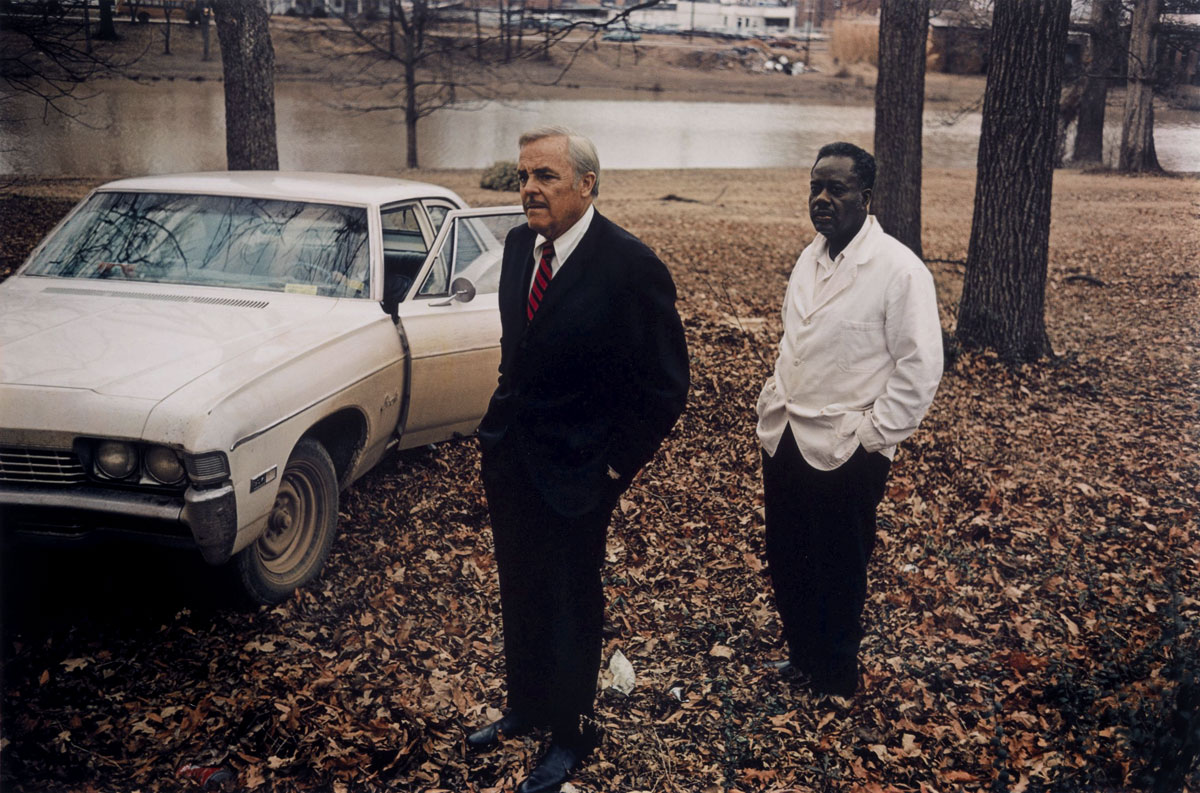
For an extraordinary marriage between people and their surroundings, I'd be hard pressed to find a more eloquent example than the next photo. The loyal manservant falls naturally into the body language used by his boss. But notice how the men are echoed by the pairs of trees receding into the distance to the right - particularly the closer pair suggesting the one on the right is the sturdier of the two. I'm also struck by how there are only really three colours in the photo - the inescapable black/white contrast picked up in the car and its radiator, the house in the distance, the clothing... and all else is an autumnal shade, as if this situation is transitory: the white man's skin in fact the same ruddy brown of the leaves, earth and even the water.
From image to image, I just found myself marvelling at the photographer's eye. His seemingly instinctive way of capturing people at exactly the right time and place even allowed for some gentle humour: the girl in the back of a car, placed so accurately that the windows of the car spread out behind her like angel wings - but in a perfect inversion of the shape of her curved specs. Or, in one of my favourites from the whole exhibition (below), an early shot of a man about to cross the road, near a STOP sign. But the man also is the STOP sign in human form - the timing is such that his awkwardly raised leg, mid-gait, puts his rigid frame at the same slightly-skewed angle.
Sometimes Eggleston's self-removal is problematic - the photograph of his girlfriend in tears, staring accusingly down the camera lens, is uncomfortable and unforgettable - and we occasionally feel like we're witnessing scenes we perhaps shouldn't. But in a way, I'm glad that someone who seems to have lived a life at the edges, quietly observing, is also capable of edginess - otherwise it would be easy to believe he has somehow moved among us completely unnoticed, leaving no trace but his photos. One of the most thought-provoking and involving exhibitions I've seen in years.
After these smaller-scale wonders, Georgia O'Keeffe's paintings came as a kind of blissed-out, sensory overload. I had perhaps the same pre-conception of O'Keeffe as many others - I knew her name, and of her importance, but the only pictures I really knew about were the large flowers. Much like this one:
So, one of the glories of the Tate's exhibition is its ambitious scope - GO'K's whole lifetime is covered, and the outsize flora take their place as part of her never-ending cycle of artistic development.
I will get one thing off my chest about the 'hang', so to speak - or perhaps, more accurately, the curation. GO'K's quotation "Men put me down as the best woman painter... I think I'm one of the best painters" features prominently on the posters - and it's been assembled by two women. So, while being aware that as a chap, this is not my field of expertise or comfort zone, I was expecting a full-on feminist, celebratory approach of Keeffe's originality and brilliance. I wasn't expecting quite so much focus on her husband, Alfred Stieglitz, photographer and artistic mover/shaker. Clearly, they were important to each other, but after a few rooms, I was finding Stieglitz to be something of an annoyance. For example, while O'Keeffe seems to have willingly acted as his muse, did we really need to see so many of his photos of her - isn't that his work? Or the fact that they both produced city scapes (like the painting below) is surely not cast-iron evidence that he was an inescapable influence, but rather a natural outcome of the fact they both lived in a city. Worse, he apparently perpetuated and galvanised the tendency of critics to see G'OK's work as erotic, irritating her no end. I don't want him airbrushed completely out of her story, but I resented his material taking up space that could have been given to more of hers.
It seems to me that O'Keeffe's work is more about the sensory, rather than the sensual - the paintings suggest heightened levels of experience, rather than contrived layers of meaning. Some of the most breathtaking pieces early on in the exhibition are her abstracts inspired by music: communicating what synaesthesia (the condition that allows people to experience a stimulation 'across' the senses - for example, to see music as colours or shapes) might actually be like for those of us in the relative dark. And the famous large-scale flowers - which were also subject to the 'sexual' over-simplification - in fact force the viewer to engage with the plants' beauty and intricacy to a hyper-real extent, since it would be impossible to experience the bloom in such overwhelming dimensions in the wild.
As time went on and O'Keeffe moved herself physically further into nature - initially the rural Lake George area of New York State and ultimately her extended stays in New Mexico - the art became not so much surreal as more totemic, emblematic. The exhibition finds room for her skulls and bones, shown almost levitating against the bright landscape, like bleached-out, sun-drenched vanitas still lifes... contrasting with her 'Black Place' paintings of remote, monochrome hills. Telling details zap you like lightning bolts from her abstract work - as below, where the interlocked sections of bone are echoed by the fissures in the distant rock face.
One of my own favourite paintings is far less elemental. But this East River view, I think, combines so many features of her greatness. I love the way the entire view is slightly slanted left, as our eye rarely sees everything as totally flush and horizontal. The buildings, while totally realistic, strike us as a pattern of recurrent, near-regular shapes, seemingly with the potential to repeat and regenerate for ever. And her billowing clouds are present in the smoke pouring from the funnels and chimneys. In the haze, the hue of the open land far off picks up the colour of the water. I couldn't tell you how long I stood transfixed, staring into this.
Two artists utterly poles apart in attitude and approach: disinterested observation versus deep engagement. But both seem to arrive at the same instruction - stop, and look more closely.
Eggleston is, in my opinion, rightly celebrated for his impassive gaze at Americana, and I can see why he's been compared to, say, Hopper in achieving that sense of detached melancholy (in film rather than paint, of course). WE does not confine himself to photographing only people - far from it. But as regular Specs perusers will know, portrait photography is something I'm very fond of doing myself, so the opportunity to see a large amount of his work in this genre and gain some inspiration from it was irresistible.
Photograph an empty location, and you can capture stillness. But once people are in there, movement or change is always implied - there cannot be total disengagement. The two 'forces' going on in many of these pictures, then - WE's apparent 'attempt' (deliberately subverted, I'm sure) to shoot his subjects with the same coolness as his landscape work, and the simple fact of their energy and presence pushing against this - make for a wonderful tension. If anything, I thought of film-makers: the saturated false normality of Lynch, or the eerie symmetry of Kubrick.
Take the shot below. At first glance, it's tempting almost to laugh at the old-fashioned hairstyle and see the photo as almost satirical, condescending. But that tight vertical line of focus shows the similarity of the grips and the necklace. Geometry is in evidence everywhere here - follow the lines from the corners of the near seat, through the corners of the far seat, to the 'corners' of the hairdo. The friends/couple are merged into one shape, making two opposite triangles, giving them a deep connection without ever needing to reveal their faces. The only thing breaking this balance is that the two cigarettes (both somehow 'equally' out of focus) mirror each other 'into' rather than across the picture, lending the subjects an even stronger link.
For an extraordinary marriage between people and their surroundings, I'd be hard pressed to find a more eloquent example than the next photo. The loyal manservant falls naturally into the body language used by his boss. But notice how the men are echoed by the pairs of trees receding into the distance to the right - particularly the closer pair suggesting the one on the right is the sturdier of the two. I'm also struck by how there are only really three colours in the photo - the inescapable black/white contrast picked up in the car and its radiator, the house in the distance, the clothing... and all else is an autumnal shade, as if this situation is transitory: the white man's skin in fact the same ruddy brown of the leaves, earth and even the water.
From image to image, I just found myself marvelling at the photographer's eye. His seemingly instinctive way of capturing people at exactly the right time and place even allowed for some gentle humour: the girl in the back of a car, placed so accurately that the windows of the car spread out behind her like angel wings - but in a perfect inversion of the shape of her curved specs. Or, in one of my favourites from the whole exhibition (below), an early shot of a man about to cross the road, near a STOP sign. But the man also is the STOP sign in human form - the timing is such that his awkwardly raised leg, mid-gait, puts his rigid frame at the same slightly-skewed angle.
Sometimes Eggleston's self-removal is problematic - the photograph of his girlfriend in tears, staring accusingly down the camera lens, is uncomfortable and unforgettable - and we occasionally feel like we're witnessing scenes we perhaps shouldn't. But in a way, I'm glad that someone who seems to have lived a life at the edges, quietly observing, is also capable of edginess - otherwise it would be easy to believe he has somehow moved among us completely unnoticed, leaving no trace but his photos. One of the most thought-provoking and involving exhibitions I've seen in years.
After these smaller-scale wonders, Georgia O'Keeffe's paintings came as a kind of blissed-out, sensory overload. I had perhaps the same pre-conception of O'Keeffe as many others - I knew her name, and of her importance, but the only pictures I really knew about were the large flowers. Much like this one:
So, one of the glories of the Tate's exhibition is its ambitious scope - GO'K's whole lifetime is covered, and the outsize flora take their place as part of her never-ending cycle of artistic development.
I will get one thing off my chest about the 'hang', so to speak - or perhaps, more accurately, the curation. GO'K's quotation "Men put me down as the best woman painter... I think I'm one of the best painters" features prominently on the posters - and it's been assembled by two women. So, while being aware that as a chap, this is not my field of expertise or comfort zone, I was expecting a full-on feminist, celebratory approach of Keeffe's originality and brilliance. I wasn't expecting quite so much focus on her husband, Alfred Stieglitz, photographer and artistic mover/shaker. Clearly, they were important to each other, but after a few rooms, I was finding Stieglitz to be something of an annoyance. For example, while O'Keeffe seems to have willingly acted as his muse, did we really need to see so many of his photos of her - isn't that his work? Or the fact that they both produced city scapes (like the painting below) is surely not cast-iron evidence that he was an inescapable influence, but rather a natural outcome of the fact they both lived in a city. Worse, he apparently perpetuated and galvanised the tendency of critics to see G'OK's work as erotic, irritating her no end. I don't want him airbrushed completely out of her story, but I resented his material taking up space that could have been given to more of hers.
It seems to me that O'Keeffe's work is more about the sensory, rather than the sensual - the paintings suggest heightened levels of experience, rather than contrived layers of meaning. Some of the most breathtaking pieces early on in the exhibition are her abstracts inspired by music: communicating what synaesthesia (the condition that allows people to experience a stimulation 'across' the senses - for example, to see music as colours or shapes) might actually be like for those of us in the relative dark. And the famous large-scale flowers - which were also subject to the 'sexual' over-simplification - in fact force the viewer to engage with the plants' beauty and intricacy to a hyper-real extent, since it would be impossible to experience the bloom in such overwhelming dimensions in the wild.
As time went on and O'Keeffe moved herself physically further into nature - initially the rural Lake George area of New York State and ultimately her extended stays in New Mexico - the art became not so much surreal as more totemic, emblematic. The exhibition finds room for her skulls and bones, shown almost levitating against the bright landscape, like bleached-out, sun-drenched vanitas still lifes... contrasting with her 'Black Place' paintings of remote, monochrome hills. Telling details zap you like lightning bolts from her abstract work - as below, where the interlocked sections of bone are echoed by the fissures in the distant rock face.
One of my own favourite paintings is far less elemental. But this East River view, I think, combines so many features of her greatness. I love the way the entire view is slightly slanted left, as our eye rarely sees everything as totally flush and horizontal. The buildings, while totally realistic, strike us as a pattern of recurrent, near-regular shapes, seemingly with the potential to repeat and regenerate for ever. And her billowing clouds are present in the smoke pouring from the funnels and chimneys. In the haze, the hue of the open land far off picks up the colour of the water. I couldn't tell you how long I stood transfixed, staring into this.
Two artists utterly poles apart in attitude and approach: disinterested observation versus deep engagement. But both seem to arrive at the same instruction - stop, and look more closely.
Saturday, 8 October 2016
Cross purposes: 'Norma' at the ROH
Bellini's opera 'Norma' is justifiably famous for at least two reasons: as one of the most highly-regarded works in the 'bel canto' genre (an especially florid style of Italian singing - gorgeousness almost for its own sake), and having, in the title role, one of the most demanding parts in the entire repertoire.
The new production of 'Norma' at the Royal Opera House had already made the headlines long before the actual run. Anna Netrebko withdrew from debuting in the role about a month after the season was announced. However, within a week or so, Sonya Yoncheva - also taking on Norma for the first time - had been cast in her place. This generated a bit of 'BUT IS SHE A NORMA?'-style speculation (surely it's the same with any new incumbent of this particular role). But as someone who is happiest when their corner of social media is in 'polite' mode, I was really pleased to find that most reactions I saw to SY's involvement were of curious, optimistic interest.
I was excited, too, because I knew SY only through her lovely album 'Paris, mon amour' - I'd never heard her live on stage. And I was particularly intrigued by the swift return to the ROH of director Àlex Ollé (of La Fura dels Baus, the troupe behind the brilliant recent production of Enescu's 'Oedipe', which I wrote about here).
To canter briefly through the plot... the Romans have occupied Gaul. The Druids are governed by a kind of first family, namely Oroveso, their chief, and his daughter Norma, their high priestess. These aren't the chilled-out hippy Druids you'd expect to find hanging around Stonehenge; in fact, under Oroveso's leadership, they are itching to make war on the invaders. Norma advocates peace, not least because she has had two children on the quiet with a Roman lover, Pollione.
Pollione, card-carrying complete bastard, has actually transferred his affections to another, junior priestess called Adalgisa. Adalgisa puts up some resistance, but ultimately agrees to leave with Pollione. However, she feels the need to explain her impending departure to Norma. The truth comes out just as Pollione turns up to collect Adalgisa, and there is, of course, an almighty dust-up. Both women are furious to find out about Pollione's deception - so he leaves by himself. But Norma's rage is apocalyptic.
She comes very close to killing their children in a Medea-like act of revenge, but stops herself. Adalgisa returns to her vows after failing to persuade Pollione to come back to Norma - at which point things, as they say, escalate quickly. Hearing that the Romans plan to take Adalgisa back by force, Norma stirs the Druids up to war. Pollione is arrested and brought in after being caught breaking back into the temple. As a sacrificial victim is needed for the war ceremony, Norma shocks the entire ensemble by revealing her secret - including her children, for the first time, to hands-off granddad Oroveso - and proclaiming herself as the offering. She dies with Pollione on the pyre.
High octane stuff. But - as a 'bel canto' high watermark - however sorry or tense the situation, it's all underpinned by utterly gorgeous music. If, like me, you're a bit more used to later opera where the orchestra tends to track the mood of the action more closely, it can at times seem a little surreal or ironic, as if the score has passed through music written since and out the other side.
But of course, it's neither of those things. As the convention of the time, it would not have had this strangeness-in-hindsight. And the cast, playing it completely straight, bring out a total sincerity. Somehow, the loveliness of the melodies makes it more unbearable that this is happening to these people. Norma has a rightly-celebrated solo aria 'Casta diva', where she prays for peace. But for me, this was possibly surpassed by the writing for duet and trio near the end of Act I - where first, Adalgisa's confession and Norma's compassion ripple over each other until realisation dawns, then - once Pollione turns up - their fury erupts, but in sublimely intertwined lines: as any two voices fall back, the third fills the gap to take its place in the argument.
(The ROH's clip of Sonya Yoncheva singing 'Casta diva'.)
Sonya Yoncheva was magnificent. No problem supplying the seemingly effortless beauty in the voice, but also dominant and commanding when necessary. I was convinced by the body language and attitude that this was someone who could control and influence a mob. She gave the character moments of fearsome physicality - a cry of rage at the exact moment the lights went out on Act 1, and later on, an unchecked assault on a gong, when in war mode. The supporting cast were all on form, too. Sonia Ganassi (apparently performing with a cold; still great) brought out the initially weak and anguished Adalgisa's latent grit, and Joseph Calleja was suitably thuggish as arch-git Pollione - terrific sound, but if I had to change one thing, I'd get him to interact with the other characters more, rather than declaim outwards quite so much. (This, of course, could have been how he was directed.)
I was also hugely impressed by the staging and production. The forest, gleaming in darkness, seems very strange and stylised, until you realise the trees are made entirely of what must be hundreds of crucifixes. (A chilling realisation of how the wood is described by Pollione and his friend Flavio as evil, containing death.) The 'Druids' in this production are definitely being aligned with Christianity - it's hard to miss the comment on aggression/repression in contemporary religion - but the specifics are nicely blurred: the swinging censer and tree-crucifixes might suggest Catholicism but if so - Norma and Adalgisa would not be priests.
Ollé revisits some of the time-shift concepts that helped make his 'Oedipe' production so fascinating. In the first half, the characters wear vaguely recent/contemporary military and clerical garb... but after the interval, Norma's children are shown in an ultra-modern flat, with 'Watership Down' on the TV (as if these kids aren't traumatised enough!) and a spacehopper taking centre-stage. Church and state seem to blur further as Norma and Adalgisa appear in business-like trouser suits, religion and war now a matter of admin - of getting things done.
To me, this meant that every aspect of the opera carried a tension between what things 'ought to be', and what they are. I've already mentioned the way the divine music can seem a mismatch for the ugly subject matter, and Ollé's overall production looks to that model. All the individual elements we see make sense: the costumes, the props, the locations... but they only 'add up' in the opera's alternative universe where we find ourselves. We can absorb the critique of today's society, without missing out on that wave of escapism opera gives us, as a modern audience.
The final image of the production is an astonishing coup de theatre, as the partially-hidden sacrificial pyre itself takes the shape of a stage-high burning cross - queasily reminding the audience of the Druid's KKK-style headgear and finally igniting the underlying theme of where fundamentalist rule inevitably leads: to death. And more than that, to death of the innocent.
An evening of real depth and power, stunningly performed and realised.
The new production of 'Norma' at the Royal Opera House had already made the headlines long before the actual run. Anna Netrebko withdrew from debuting in the role about a month after the season was announced. However, within a week or so, Sonya Yoncheva - also taking on Norma for the first time - had been cast in her place. This generated a bit of 'BUT IS SHE A NORMA?'-style speculation (surely it's the same with any new incumbent of this particular role). But as someone who is happiest when their corner of social media is in 'polite' mode, I was really pleased to find that most reactions I saw to SY's involvement were of curious, optimistic interest.
I was excited, too, because I knew SY only through her lovely album 'Paris, mon amour' - I'd never heard her live on stage. And I was particularly intrigued by the swift return to the ROH of director Àlex Ollé (of La Fura dels Baus, the troupe behind the brilliant recent production of Enescu's 'Oedipe', which I wrote about here).
To canter briefly through the plot... the Romans have occupied Gaul. The Druids are governed by a kind of first family, namely Oroveso, their chief, and his daughter Norma, their high priestess. These aren't the chilled-out hippy Druids you'd expect to find hanging around Stonehenge; in fact, under Oroveso's leadership, they are itching to make war on the invaders. Norma advocates peace, not least because she has had two children on the quiet with a Roman lover, Pollione.
Pollione, card-carrying complete bastard, has actually transferred his affections to another, junior priestess called Adalgisa. Adalgisa puts up some resistance, but ultimately agrees to leave with Pollione. However, she feels the need to explain her impending departure to Norma. The truth comes out just as Pollione turns up to collect Adalgisa, and there is, of course, an almighty dust-up. Both women are furious to find out about Pollione's deception - so he leaves by himself. But Norma's rage is apocalyptic.
She comes very close to killing their children in a Medea-like act of revenge, but stops herself. Adalgisa returns to her vows after failing to persuade Pollione to come back to Norma - at which point things, as they say, escalate quickly. Hearing that the Romans plan to take Adalgisa back by force, Norma stirs the Druids up to war. Pollione is arrested and brought in after being caught breaking back into the temple. As a sacrificial victim is needed for the war ceremony, Norma shocks the entire ensemble by revealing her secret - including her children, for the first time, to hands-off granddad Oroveso - and proclaiming herself as the offering. She dies with Pollione on the pyre.
High octane stuff. But - as a 'bel canto' high watermark - however sorry or tense the situation, it's all underpinned by utterly gorgeous music. If, like me, you're a bit more used to later opera where the orchestra tends to track the mood of the action more closely, it can at times seem a little surreal or ironic, as if the score has passed through music written since and out the other side.
But of course, it's neither of those things. As the convention of the time, it would not have had this strangeness-in-hindsight. And the cast, playing it completely straight, bring out a total sincerity. Somehow, the loveliness of the melodies makes it more unbearable that this is happening to these people. Norma has a rightly-celebrated solo aria 'Casta diva', where she prays for peace. But for me, this was possibly surpassed by the writing for duet and trio near the end of Act I - where first, Adalgisa's confession and Norma's compassion ripple over each other until realisation dawns, then - once Pollione turns up - their fury erupts, but in sublimely intertwined lines: as any two voices fall back, the third fills the gap to take its place in the argument.
(The ROH's clip of Sonya Yoncheva singing 'Casta diva'.)
Sonya Yoncheva was magnificent. No problem supplying the seemingly effortless beauty in the voice, but also dominant and commanding when necessary. I was convinced by the body language and attitude that this was someone who could control and influence a mob. She gave the character moments of fearsome physicality - a cry of rage at the exact moment the lights went out on Act 1, and later on, an unchecked assault on a gong, when in war mode. The supporting cast were all on form, too. Sonia Ganassi (apparently performing with a cold; still great) brought out the initially weak and anguished Adalgisa's latent grit, and Joseph Calleja was suitably thuggish as arch-git Pollione - terrific sound, but if I had to change one thing, I'd get him to interact with the other characters more, rather than declaim outwards quite so much. (This, of course, could have been how he was directed.)
I was also hugely impressed by the staging and production. The forest, gleaming in darkness, seems very strange and stylised, until you realise the trees are made entirely of what must be hundreds of crucifixes. (A chilling realisation of how the wood is described by Pollione and his friend Flavio as evil, containing death.) The 'Druids' in this production are definitely being aligned with Christianity - it's hard to miss the comment on aggression/repression in contemporary religion - but the specifics are nicely blurred: the swinging censer and tree-crucifixes might suggest Catholicism but if so - Norma and Adalgisa would not be priests.
Ollé revisits some of the time-shift concepts that helped make his 'Oedipe' production so fascinating. In the first half, the characters wear vaguely recent/contemporary military and clerical garb... but after the interval, Norma's children are shown in an ultra-modern flat, with 'Watership Down' on the TV (as if these kids aren't traumatised enough!) and a spacehopper taking centre-stage. Church and state seem to blur further as Norma and Adalgisa appear in business-like trouser suits, religion and war now a matter of admin - of getting things done.
To me, this meant that every aspect of the opera carried a tension between what things 'ought to be', and what they are. I've already mentioned the way the divine music can seem a mismatch for the ugly subject matter, and Ollé's overall production looks to that model. All the individual elements we see make sense: the costumes, the props, the locations... but they only 'add up' in the opera's alternative universe where we find ourselves. We can absorb the critique of today's society, without missing out on that wave of escapism opera gives us, as a modern audience.
The final image of the production is an astonishing coup de theatre, as the partially-hidden sacrificial pyre itself takes the shape of a stage-high burning cross - queasily reminding the audience of the Druid's KKK-style headgear and finally igniting the underlying theme of where fundamentalist rule inevitably leads: to death. And more than that, to death of the innocent.
An evening of real depth and power, stunningly performed and realised.
Subscribe to:
Posts (Atom)