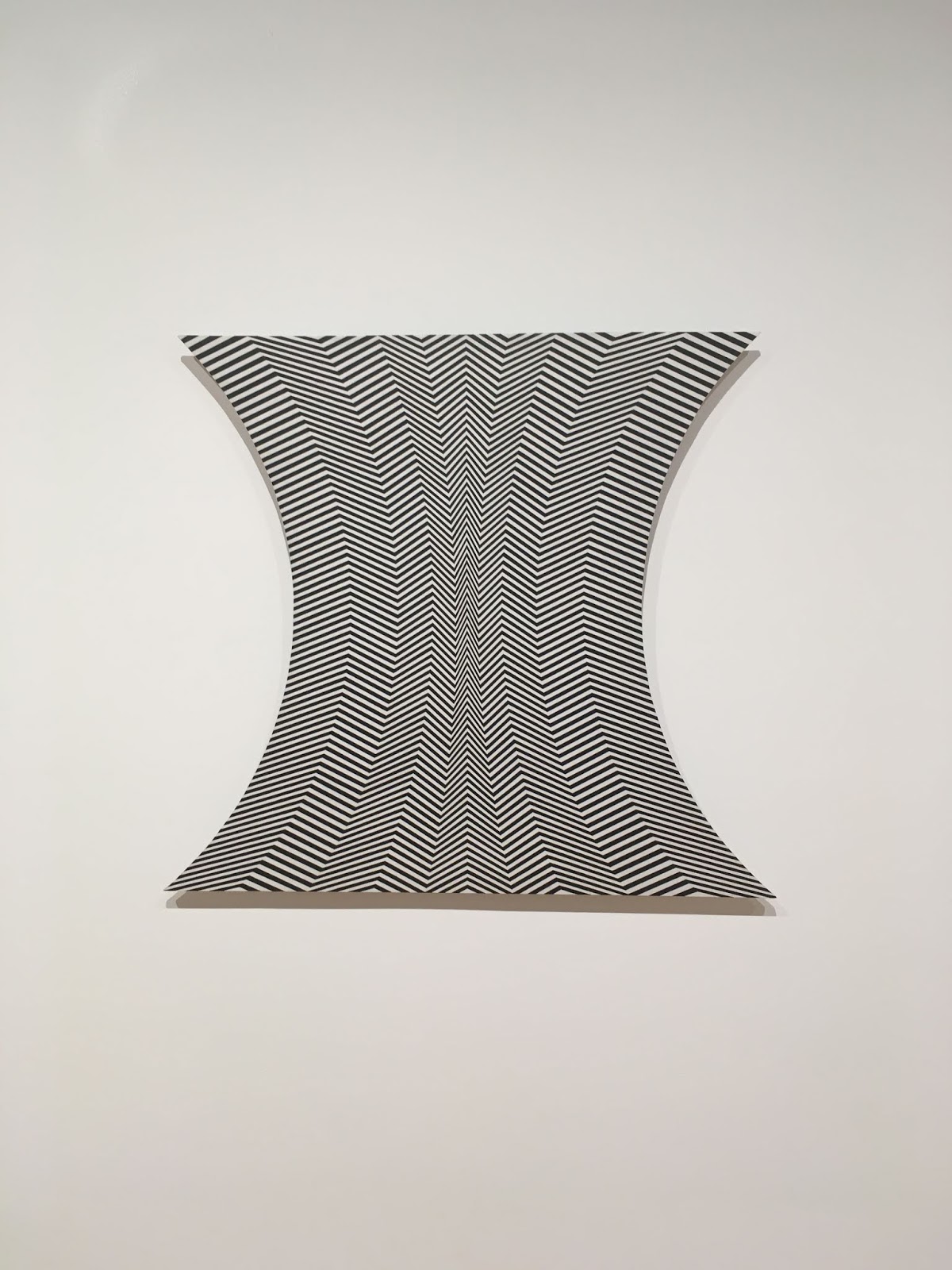
Sunday, 1 December 2019

Shape shifter: Bridget Riley at the Hayward Gallery

A 'photo-blog' this time, following my visit to the Bridget Riley retrospective exhibition, running at the Hayward Gallery in London's Southbank Centre until 26 January 2020.


Riley's work was among the very first abstract art I loved. While I had no idea what 'op art' was at the time, I always loved 'optical illusion' puzzles and curiosities as a kid. No surprise, then, that I've always been mesmerised by Riley's manipulation of colours (or the lack of them) and shapes (or the spaces between them) - and the grand scale on which she achieves it.

Here, I'm going to take you on a short tour of some of my highlights of the show. Nothing - not even a copy of the handsome catalogue - can really replace going to see the pieces in the 'flesh'. You have to imagine many of them filling your field of vision, or being able to get close enough to see the subtle variations in the lines and patterns, or marvel at the brushwork's precision in the service of such restrictive, rigorous designs.


The dazzling black and white images - surely her most recognisable work to this day - have this almost frightening ability to make you see false shapes, or a third dimension that isn't there, especially as you move forward and back or side to side in front of the painting. In some cases, I had that weird sensation not unlike when the eyes of a portrait seem to follow you around the room - but here it's a void that responds to your actions. Then I think the art touches on something almost terrifying, apocalyptic.


As a comprehensive survey, the exhibition covers some aspects of her career that I hadn't previously been aware of - for example, her admiration for Seurat. While the art she went on to produce doesn't resemble Seurat's, she was influenced by his approach - and the curation does its best to tease this out:


We also get to see some of her very early pieces...


I was fascinated to see signs in the 'pre-abstract' work of possible later preoccupations: the 'rejections' of the face, each hidden, altogether missing, or fading, somehow incomplete; shapes and their shadows; geometric lines.

The show also took in some less familiar media - for example, some of her works on perspex (where the images feel almost like trademarks or esoteric logos of some kind), and her only 3-D large-scale installation, where you can walk inside and be surrounded by a Riley painting - notwithstanding the short queue, very few people stayed in there for long!


But the more familiar I am with an artist and the more I go to see their work, the more easily I can let my mind wander onto other aspects ... in particular, the 'hang'. I was struck by how sometimes an exhibition can find its perfect gallery, and that has definitely happened here. My final sequence of snaps is meant to give you an idea of just what it was like to move around in the space and experience these pictures: surely the white and grey austere lines of the Hayward were just waiting for Riley to come along.

(Brief warning - as this is a little like street photography with a roof, I'm anxious that no-one in the photos can be readily identified. As a result, I experimented with the editing functions on my laptop and, in an unexpected turn of events, managed to completely remove two peoples' heads. I've actually left these individuals in the pictures as a kind of tribute to Riley's erasure of faces. Please rest assured that I didn't actually decapitate anyone in the gallery to achieve my aesthetic aims...)

I hope you've enjoyed the photographs. You can find details of the exhibition here on the Southbank Centre website.


Monday, 18 November 2019

Cross purposes: 'The Greek Passion', Opera North

More musical travels, this time to the Theatre Royal, Nottingham to see Opera North's production of Martinů's 'The Greek Passion'. A completely new work to me, I was quite unprepared for how moving - and ultimately overwhelming - a piece it is. And, much like everything else I've seen so far from Opera North, this production felt supremely confident, generating a grandeur above its means... while, at the same time, communicating something real, focused; drawing out extraordinary drama from previously ordinary lives.


The opera is based on 'Christ Recrucified', a novel by Nikos Kazantzakis (who also wrote the novels that inspired 'The Last Temptation of Christ' and 'Zorba the Greek'). The villagers of Lycovrissi stage a passion play every Easter Sunday; once the performance is over, the powerful priest Grigoris immediately casts the roles for the following year. The devout nature of the community is such that the new group of 'actors' bond straightaway and begin studying and rehearsing their characters.

Before long, the innate power of the gospel story starts to affect the cast, who take on aspects of their biblical alter-egos. In particular, the quiet shepherd Manolios - playing Jesus - turns inward, allowing his fiancée to drift away into a rival's arms. The play's Mary Magdalene, Katerina, is attracted to Manolios, but he resists her affections and urges her towards piety. However, her current lover, Panait - as Judas - watches this chaste romance play out, and broods...

Meanwhile, as the players wrestle with their inner demons, a true test of their Christian values presents itself. Refugees from another village, destroyed by the Turks, arrive seeking help. Immediately fearful and suspicious, Grigoris turns them away, despite the heartfelt and eloquent pleas of their leader Fotis, himself a priest. However, the players advise the refugees to remain close by, on the nearby mountain.

Tensions rise as time passes and the actors identify more and more strongly with their roles. Manolios preaches compassion for the refugees; Katerina takes them milk; Yannakos (the postman playing Peter) is tempted by one of the village elders to steal from the new arrivals but discovers his conscience in time. Ultimately, however, Grigoris manages to turn the village against both the refugees and Manolios. In the melee, Panait - fulfilling his character's destiny in the most chilling way imaginable - seizes the opportunity to murder Manolios ... and the crisis abates. Lycovrissi enjoys a normal Christmas, with the hungry, frozen refugees dying outside its borders.

This opera must make tremendous demands of its soloists' acting abilities. While we never see the full passion play as a piece of discrete drama (chaos erupts too soon), from the opera's outset we watch the players not only take on a further character of their own, but then mine a third seam as the lines become blurred between their fiction and their reality. Each of them managed to embody what seemed to me one of the work's more mystical aspects: that Grigoris's casting seems in some way pre-ordained, and that each villager selected has, somehow, been waiting to inhabit their role all along.


Nicky Spence as Manolios was masterful in this respect. Even when we meet the character for the first time, he is oddly apart, distracted - and somehow unsuited to earthly preoccupations like romantic love. For such a vocal powerhouse, Spence gave a bravely quiet performance, establishing the accidental Christ figure with wandering, distracted looks and diffident body language. Only with his increasing confidence as a preacher came the familiar richness of tone and caressing volume.

It seems harsh to single others out, but still firmly lodged in my mind's eye (and ear) are Magdalena Molendowska's Katerina finding a kind of peace in charity, Paul Nilon's haunted, conflicted Yannakos and Jeffrey Lloyd-Roberts interjecting cries of hate and horror to create Panait's seething, inarticulate rage.

Turning outside the village, John Savournin was a compelling presence as the refugees' spiritual and political leader, Fotis. Stressing these two sides of his character is important, as Savournin's delivery conveyed both compassion and strength, showing us a man of great dignity and self-possession, even when he and his people are at their lowest ebb.

While the performances were impassioned and visceral, the unforgiving poignancy of the plot was underlined by the staging. A casual glance at photos of Christopher Alden's production will immediately tell you that the refugees are represented by effigies. But in fact, this oversimplifies a beautifully subtle idea. Each member of the formidable Chorus of Opera North carries one of the 'bodies'. As such, when the figures are placed in rows en masse, their oppressed silence is visually stifling; yet when the action calls for the Chorus to give the refugees a joint voice, the impact is overwhelming. No-one who saw and heard the 'Kyrie' at the end of Act 2 is likely to forget it, an explosion of tribal anguish and devotion.


But the double expression of body and voice works brilliantly too, as identities merge and swap. For example, an old refugee, about to die, handed his effigy to the villager Yannakos: the 'body' still in his arms as the singer crawled across the stage to die in his grave. To suggest so much - separation of soul from body; the emptiness of a corpse once the light has gone out; the 'levelling' and even communion brought by death to the haves and have-nots - with such stark visuals: elegance and eloquence in tandem.

I loved the layers of meaning that emerged from this apparent simplicity. The monochrome effect of the refugees (white effigies, black-clad Chorus) contrasted with the ironic opulence of the passion players' coloured robes. (Their stylised posture against the black backdrop reminded me of Bill Viola's 'video paintings', themselves influenced so heavily by older religious art.) The placing of the characters in a 'bikers and barmaids' environment with rustic, menial jobs ensuring there is only the merest sliver of difference between their situation and that of the refugees.

But really my final paragraphs of praise should go to Opera North's Orchestra, conducted here by their incoming Musical Director, Garry Walker. The score is really a character in itself, with Martinů's storytelling so economical (brief, partly-spoken links ensure the story rockets along from incident to incident) that he succeeds in creating an innovative hybrid that feels at times like a purely choral work as much as an opera. This mass-like purity is offset, however, by strains of folk and roots music: in the Theatre Royal, it appeared that two or three orchestra members took turns in a kind of makeshift Unusual Instrument Booth to the conductor's left - one wielding an accordion, for example - to anchor the sound to the soil. To me, the orchestra just felt buoyant - shifting mood, register, tempo as if they were generating a live soundtrack to the stage action.

While the run has now ended, 'The Greek Passion' was broadcast on BBC Radio 3 - which means you can still hear it on their website here, or through the BBC Sounds app. At the time of writing, it will be up for another 20 days or so... taking you to around 8 December. Please listen if you can - it doesn't come around too often and Opera North have done it incredible justice.

(Photos from the Opera North website, with the two production stills by Tristram Kenton.)

Monday, 11 November 2019

"It feels like love": Barb Jungr, 'Bob, Brel and Me'

This post first appeared on Frances Wilson's excellent ArtMuseLondon website. For a handsome range of reviews and thought pieces covering all genres of art and music, please pay the site a visit here.

*

A new album by Barb Jungr is always a cause for celebration, but it's a particular delight to be able to write about what must be one of her very finest recordings. 'Bob, Brel and Me' is the kind of coherent, complete - and importantly, open-hearted and generous - release that makes a long-term fan like me want to take an armful of copies out and press them into the hands of friends, relatives, even unsuspecting passers-by. I'd just have time to say, "If you want to understand why this artist is so special, take a listen to this. It's all in there"... before moving on to my next target. But I will try to explain here, too.

For those of you yet to encounter Barb Jungr's music, I would say the closest genre fit is jazz - that's the section where you'll find her CDs. But in fact, I think she's one of the finest interpreters of  modern song - any song - we currently have. Whether it's a number as old as the hills, rehearsed and retrod by hundreds of other musicians, or something relatively new or obscure - songs undergo a genuine transformation in her hands, and you never listen to them in quite the same way again. While the material might look like jazz - acoustic, usually piano-based, partly improvisatory - it doesn't always feel like it. Jungr ranges across folk and rock for source material, especially the singer-songwriter lineage of the 60s and 70s. At the same time, somehow, she inhabits a world of cabaret and chanson: live, she is absolutely fearless, unpredictable and magnetic - totally unafraid to take the audience on a journey where they have no idea of the destination.

This powerful performing style might partly explain why, in particular, she has a special gift for covering songs by men. (One of my favourite discs from her back catalogue is called 'The Men I Love: the New American Songbook' - featuring material by David Byrne, Todd Rundgren, Paul Simon, Leonard Cohen and Bruce Springsteen among others.) But the Man She Loves The Most in this context is almost certainly Bob Dylan, who has two whole Jungr albums to himself (the mighty 'Every Grain of Sand' and the compilation 'Man in the Long Black Coat') and finds his way in some shape or form onto many of the others.

I don't think it's an accident that these blokes are especially renowned and valued for their lyrics - complex, intriguing words and images come pouring out of them - so their work immediately lends itself to Jungr's storytelling charisma and technical precision (the way she seems able to communicate such emotion while dancing around the melodies and preserving crystal-clear diction is worthy of several air-punches throughout this new CD alone). A superb songwriter herself, Jungr's own lyrics are witty, tender and rich in detail, so it's an extra treat when one of her records features a few self-penned tracks.

Essentially, I think her versions of this kind of  'male canon' are so successful because she has an uncanny ability to take the pulse of a song. Her strength and tenacity mean the material retains its grip, but at the same time she punctures any aggression or 'toxicity' in the masculinity - a double threat.


So we come to the latest record, which seemes designed to bring together these three key areas of her craft: 'Bob' is of course Dylan, now accompanied by Jacques Brel to represent the chanson element, and a clutch of mostly new songs written by Jungr with a range of collaborators. Mixing up these three groups of songs results in a seamless listen, due not only to Jungr's voice, but the talents of a really top-notch band - tight and responsive, every track seems to 'evolve' as you listen. There's a large cast, but if I had to mention two specific players who have leapt out at me in the first couple of listens, it would be pianist and arranger Jenny Carr and drummer Rod Youngs.

Two songs sequenced together near the start really showcase their talents. 'Jacky' (Brel) and 'Mr Tambourine Man' (Dylan) make a perfect pair, presenting the 'song and dance man' troubadour side of both their creators. Accordingly, Youngs lifts a terrific version of 'Jacky' with the merest nod to the military might of the original, but with a world-weary, buffeted beat that, more than keeping time, colours the mood of the song around it. While on the other hand, 'Mr Tambourine Man' might be a song that almost everyone thinks they know inside out (especially through the Byrds version) - but here, Carr's intricate arrangement makes her own piano part relatively sparse, but crucially features a tolling, slightly off-kilter, bell-like note, over and over again. It gives the song a flavour of the cyclic, eternal, like a jazz take on 'Winterreise's hurdy-gurdy man. And on both, Jungr weighs each word to perfection, making you wonder how she's actually managing to get through every syllable-packed line while teasing new variations and additions out of the tunes.

But the whole album is full of  commanding vocal performances. 'The Cathedral' (Brel) exchanges the manic intensity of the original with more of a seductive slow-build, Jungr's vocal managing to caress the melody with more layers of attractive embellishment - while at the same time becoming more conversational and persuasive. I'm still not sure how she manages to communicate multiple, at times conflicting moods with just the timbre of her voice, but she does. Another song that benefits from this stately attention to detail is Dylan's 'Buckets of Rain', which here is a hymnal blues underpinned by organ and double bass, elevating the earthly to something spiritual: accordingly Jungr moves apparently effortlessly between a delicate soar and a breathy intimacy.

One pleasing side-effect of these regular returns to Dylan is that the theme of each project overall affects the kind of light Jungr shines on his work. Here, Barb and band have placed him squarely in the Brel Building, with accordion decorating 'Buckets of Rain', and jazz-club piano and sax launching a propulsive pincer attack on the more Bob-like harmonica solo. 'Simple Twist of Fate' is sheer joy from start to finish, with the twist of the title finding its way into the vocal treatment, Jungr varying the circle of the vocal melody or pace while the band changes keys like they were gears.

Scattered among these masterful covers are several infectious originals, seemingly written and scored to stand shoulder to shoulder with the two other 'B's. 'In the Secret Spaces' (written with Jamie Safir) makes more of Youngs's delicately hyperactive drumming, the two-left-feet rhythm matching the bright, conversational tone of the vocal ("the moon - my God, the moon is huge!"), while opener 'Rise and Shine' - a co-write with Level 42's Mike Lindup, gives us tragicomedy in both lyrics and music, as Jungr cheerfully puns and rhymes her way through an agonising break-up story as the band seek to constantly buoy her up. My favourite new song on the record was also written with Lindup: 'Incurable Romantic' casts a characteristically amused look at the old clichés - what concision there is in lines like "Falling free / Into those arms, and no net / How many fish can there be in the sea?" - but set to a sublime tune of deceptively detailed beauty. Looking at the marriage of humour, heart and honesty in Jungr's own work illuminates how and why Dylan and Brel must be so important to her - and, in turn, what she can bring to them.

Barb Jungr has made so many great records. But there's an argument for this one being the finest distillation yet of  where she's coming from, why and how performs such compelling music, and what makes her unique. Warmly recommended.

*

You can buy 'Bob, Brel and Me' online here.

Barb Jungr's website lists all her upcoming live dates here - go go go!


Thursday, 31 October 2019

Taking soundings: Carolyn Sampson & Joseph Middleton, 'Four Last Songs'

A rare but welcome concert outside London for me, this, as I took the bus to my old university town and paid a flying visit to catch just one of the gigs in the Oxford Lieder festival. As regular readers of the Specs blog will know, soprano Carolyn Sampson and pianist Joseph Middleton are one of my 'favourite bands' - no recital duo has kept me so consistently enthralled, fascinated and delighted as these two. With the promise of hearing them perform the famous 'Four Last Songs' by Strauss - not on any of their CDs (yet!), and so much more familiar in their orchestral versions - this was unmissable.

In the event, the Strauss was the finale to a generous and richly varied selection of art song. The evening began in epic mode, with Haydn's 'Arianna a Naxos', a continuous suite of four songs taking us through Ariadne's gradual realisation that she has been abandoned by Theseus. The rest of the first half comprised four early songs by Schoenberg (Op. 2), and two songs from Mahler's 'Das Knaben Wunderhorn' contrasting 'heavenly' and 'earthly' life.

After the interval, we took a detour from lieder into melodies, specifically a sequence based on Louÿs's 'Bilitis' poems, with two settings by Koechlin bookending Debussy's three 'Chansons de Bilitis'. Finally, we heard the Strauss: not only the 'Four Last Songs', but a beautiful encore rendition of 'Morgen!'


I realise that was a somewhat dry, list-based description: but I wanted to quickly lay before you the embarrassment of riches ... And also, I think, to get across what an affecting and sublime experience this was, it's more pertinent to 'range across' the repertoire and keep sight of how all the material made for a perfect fit. Transporting in all senses: not just that feeling of uplift you get from the finest music or art, but also a sense of profound change, that you end the concert in a slightly different place, emotionally and - yes - intellectually, from where you started it. Talking about 'journeys' in this way - those of the heart and mind - might seem like a well-worn cliche by now, but sometimes that's simply what it is: you know that you've somehow travelled.

Previously, I had heard the duo perform recitals that generally matched or showcased particular discs. However, the overall theme of Oxford Lieder in 2019 was 'Tales of Beyond: Magic, Myths and Mortals'. Accordingly, they had assembled a mix of old and new - I understand that the Strauss, at the very least, is planned for a future recording project, while the Bilitis sequence was a highlight of their last release, the superb 'Reason in Madness'. However, as CS explained onstage, the programme as assembled for this gig explores the theme of heaven and earth: how they interact, how they differ.

This ability to choose and sequence sets of songs that just 'click' has been a feature of Sampson and Middleton's work right from the start of their collaboration. On this particular evening, more than the overall theme providing a sense of unity, there was also a deliberate build-up in intensity.

I spoke of journeys earlier, and it seems to me that, particularly since increasing her focus on art song around five or so years ago, Carolyn Sampson has partly been on an exploratory voyage 'into' her voice. I've always appreciated the combination of precision and purity she's rightly renowned for as a Baroque specialist, and the way she brings those qualities intact to art song performance is thrilling. However, in the close quarters and splendid acoustic of St John the Evangelist, I was more alive than ever to the way she inhabited each song and gave life to their characters with an ever-increasing variety of timbres and colours, accessing rounder, 'lower' tones as she stepped up the sensuality, and built at various points to moments of devastating volume and power (Schoenberg's 'Erhebung', say, or Koechlin's 'Hymne à Astarté'). The performance also underlined her skills as an actor-singer, her gestures and body language raising each song into its own miniature drama.

Joseph Middleton is the perfect partner throughout. An extraordinarily versatile collaborative pianist, he seems able to provide a 'through voice' for any array of styles - a look back at the duo's debut CD, 'Fleurs', reminds one how he and CS bring a sense of unity to a mix of so many composers. I've always loved hearing him play Britten, for example, the touch and control making instant sense, for me, of music that can seem so unpredictable or fractured. His playing has helped me to draw connections that I might never otherwise have done: in the Oxford concert, for example, I was struck how the piano seemed to 'dance through' the voice in both the Schoenberg and Debussy.

Their approach reached fulfilment in the Strauss. CS sang with delicacy and passion, and JM managed to achieve a truly 'orchestral' feel. But while a song like 'September' can feel so sumptuous in its full arrangement, here the duo avoided the sense that a piano/voice version was in any way a reduction. Quite the contrary - they laid the songs bare to some extent, the emotion more exposed, a crucial note of fragility, the complete absence of grandstanding, that befitted the work's valedictory nature. I was aware of myself applauding in an almost out-of-body sense - but at the same time, I was quite overcome, processing, not wanting to exit my suspended state for a short while. I knew I had been at a masterclass.

Enhancing this feeling were in fact all manner of 'suspended states': the programme was finely spun between heaven and earth; myth and reality; desire and separation; life and death... all taking place in a holy building now mostly given to the secular arts. An evening of exquisite tension, then resolution.


After every concert by CS and JM, I'm inevitably drawn back to what is already a handsome body of recorded work. As it builds, it occurs to me that they're taking their listeners on continuous voyages. Their joint programming instincts are certainly giving fans like me an education: their ability to draw together such a variety of material under compelling overall themes has meant I've been introduced to so many corners of the canon I may never have found a map to otherwise. Equally, CS - particularly on the most recent two discs, 'A Soprano's Schubertiade' and 'Reason in Madness' - is mining a rich seam on the treatment and experience of women as characters and protagonists in art song, and I'll be fascinated to see if and how this overarching motif might continue. I cannot recommend their CDs highly enough - here's a page where you can browse them all and listen to samples, courtesy of a highly reputable retailer.

*

Post-script: I've penned this write-up of the concert after recovering from a Terrible Cold. A few nights ago, I was feeling both rotten, yet strangely upbeat (could've been the drugs!) - but I couldn't face an evening full of screen work. As a result, I carried out an experiment of sorts, talking into my phone (totally unscripted, utterly unprepared) - partly about the gig, but also about the wider 'road trip', and how I felt about visiting my alma mater. If you're curious, and like your concert chat seasoned with ramblings about fearing nostalgia and battling oversized kettles, please feel free to watch it on this page. But the detail is in the piece above.

Monday, 28 October 2019

Voice coach

Specs is under the weather... so keeping typing and eyestrain to a minimum. However, after attending a terrific gig last week that I'm bursting to talk about, I've tried a little experiment: talking to you about it, instead of writing.


I hope you enjoy this slight departure from the norm. It's obviously completely unpolished, delivered without notes, and lacks the refinements and revisions I'd apply to a normal post (yes, it's true!). My brain, let alone my voice, is clearly operating in 'low power mode'. But I thought I'd post it anyway, partly because I ramble into a corner of my psyche. But mainly because it's sincere, genuine, and even several days later (and in a fug of cold), I clearly still get an emotional buzz when thinking about the concert. That's Sampson & Middleton for you.

*


Saturday, 19 October 2019

The Japes of Goth / Doom for manoeuvre / as you will

Most of the time on Specs, you'll find me writing about music and art ... but regular visitors will be familiar with another passion of mine, portrait photography. This is where I get to flex a few different creative muscles - so I feel it belongs on the blog along with everything else, the whole thing adding up to an online self-portrait of sorts.

One of the best things about focusing on portraiture is collaborating with friends who are willing to step in front of the lens. I've photographed Fliss and Tony, the subjects here, often: they're extraordinarily game, endlessly co-operative and - as experienced amateur actors - bring a whole host of ideas and, usefully, outfits to the enterprise.

This is the second shoot running (after my recent pictures of Suzanne here) where the day was far more loosely-planned and improvisational. I have in the past made meticulous location plans for sessions - and will no doubt do so again - but here we decided to wing it, relatively speaking, and aim for fast results in a small number of backgrounds. All I knew in advance was that they wanted to 'go goth' - which to me could embody a gloomy sincerity, or self-aware, slightly self-mocking melodrama... or all points in between. I'm pleased with these pictures: huge fun to do, and I like to think they convey the idea that 'dressing up and larking around' can be a serious business. I hope you enjoy them.


Sunday, 6 October 2019

The right Response: giving ENO's new writers' scheme a chance

Do you sometimes find yourself reading a feature or article that has you spluttering a little in disbelief, leaving you desperate to return a comment or find some way of putting the opposite view across, as soon as you can? (Actually, in the current political climate, that might happen to some of us every five minutes, but never mind.) This, as usual, is about music and, as you might expect with me if you visit Specs regularly, concerns English National Opera ('ENO').

Full disclosure for anyone unfamiliar: to me, 'ENO' is its performing company - the ensemble of Chorus and Orchestra. Of course it is. I am a paying customer who enjoys writing about music; not a critic, nor a commentator on the music industry. I also know that I'm artist-led, and if I have a 'favourite band' in the classical world, it's the ENO Chorus and Orchestra: I feel that whatever type of opera or production I might see at ENO, they have never actually let me down. In particular, the Chorus have gifted me some of the most adventurous, glorious, affecting, overwhelming and - importantly - skilfully-acted experiences I've had at the opera.

However, ENO is of course business as well as pleasure. Behind the scenes, things have rarely been rosy in recent memory. Financial mismanagement, Arts Council 'special measures', high-level but short-lived appointments ... all of which seem to have resulted in two key outcomes. First (particularly under the previous regime), terrible uncertainty and stress for the ensemble, who were and are the least deserving of such angst. Second, an ongoing rift between the opera media establishment - primarily critics - and the ENO administration that seems to show no sign of healing.

I know some people online see me as just an ENO 'cheerleader'. When it comes to the singers and players, I accept that label proudly. When it comes to behind the scenes, not necessarily (for example, I openly bemoaned the shocking treatment of the Chorus in the wake of the special measures). The point is, I don't confuse the two. When others willingly do this, I see the harm, and my hackles rise.

I've written before, for example, about a critic using up word count for a review, by attacking the ENO top brass of the time and openly advocating the company be shut down and re-formed. Personally, I don't think criticism exists in a moral bubble: if you reach the point where you hate the way a company is run so much, you are explicitly calling for job losses and damage to livelihoods, you should probably start focusing more on what's happening onstage than off.

The friction continues, partly I believe because the current CEO, Stuart Murphy, is an enthusiastic mouthpiece for the company on social media - so makes himself a target. Murphy's background is not in opera, meaning that some have been dismissive of his appointment from the start. The impression one gets as an observer is of an insoluble disconnect: a certain group who deride anything the incomer/upstart says or does; and a hands-on new broom who publicly bristles at the constant brickbats.

Obviously, there are misfires (ENO's own 'water-gate', where outraged attendees were made by apparently rather unsubtle security staff to pour away water from any unsealed bottles - the horror!). And some initiatives simply come up against pure cynicism - for example, the recent scheme to offer free balcony tickets to under-18s on Saturday nights drew a volley of snark about unsold seats in the Coliseum.


Ah - seats in the Coliseum. This brings us bang up to date. The most recent ENO scheme comes in two linked parts:
  • Critics will no longer receive the offer of a 'plus-one' ticket when they attend to review a show. (For context, taking a guest for free is clearly a 'perk', and recognised by critics as such. However, these extra tickets are so common among arts institutions that ENO is singling itself out with this decision.)
  • Instead, ENO is offering regular tickets to new or budding writers - chosen from a group of applicants - to try and hone their reviewing skills and have their pieces published on the company's website. This part of the scheme is called 'ENO Response'.
You can imagine how many critics have reacted to point one.

Like the scheme itself, my own reaction has two distinct parts. I'm pretty neutral on the 'plus-one' issue: there is an argument that, as ENO has been singled out for bad finances in the past, it could make a solo stand on cutting down on freebies. However, this doesn't wash, as one of Murphy's marketing initiatives has been to invite celebrities to ENO who then talk online about their lovely evening at the opera - hopefully reaching legions of potentially interested followers.

The thing is, the Coliseum really is very, very hard to sell out. There's room for everyone - critics, guests, celebs, the paying audience (lest we forget) and now the ENO Response review team. In itself, I think ENO Response is a fantastic move. You might say - "well, you're an amateur music writer, you would think that". Precisely. It is an unconventional, slightly outside-the-box idea. More of this sort of thing. (And more a little later.) Detractors pounced on it immediately - isn't this taking the expertise out of opera writing? How could these rookie reviewers be impartial? To which the reply is surely: we don't know. It's a new idea. Let's wait and see.

Sadly, I think that Murphy was mistaken in linking these two actions - which could easily have been presented as quite distinct. There was no need to frame it as ENO Response (along with the slebs) 'taking the tickets away' from the critics. It could only maintain any ongoing bad feeling. If a point was being made, I feel it has backfired - and now the genie is out of the bottle.

This season, ENO are running an unusual series of operas all based around the Orpheus myth. One critic, who seems to have grudgingly liked quite a lot about the opening performance of 'Orpheus and Eurydice', instead decided to tweet about how much he hated the refurbished foyer and champagne reception. I read a review today of 'Orpheus in the Underworld' which claimed that ENO routinely murdered operetta - citing poorly-received productions of 'The Merry Widow' and 'The Bat', but somehow neglecting to mention its extremely popular 'Iolanthe' from last season. So, I worry that in the eyes of the critics, ENO are facing another phase of doing nothing right.

But what moved me to anger - and ultimately to write this post - was an opinion piece in the latest issue of BBC Music Magazine. I won't name the writer or quote at too great a length (I feel that if you want to read chapter and verse after this, it's only fair you buy the magazine). But I believe it crosses a line, and should be called out for it.

Understandably, the feature goes through some of the objections I've mentioned above. It uses words like 'vindictive' and 'hostile', and suggests that ENO is opposed to a 'free press'. (For balance, I think we need to remember that it's the guests who can't come for free anymore, not the critics.)

Then the writer goes into out-and-out pettiness. The ENO Response writers are due to receive feedback from Lucy Basaba, who runs a website called Theatre Full Stop. Choosing sitting ducks for targets, our correspondent selects some examples of what they feel is bad writing from the website, and harumphs them onto the page, as though that somehow debunks Basaba's entire editorial or mentoring abilities. They also overlook the fact that ENO has chosen someone independent to do this - an important point, I'd have thought.

Then there's the false 'it is me?' reverse arrogance. For example: "am I just an old fuddy-duddy, imagining there should be a link between opera criticism and a working knowledge of opera?" They follow this with a conveniently ill-judged bit of promotion from Murphy about wanting people to "review opera more emotionally" - which they then dismiss as "superficial twaddle". They say that ENO's management reckon they can bypass critics in favour of "sycophantic bloggers and self-generated hype". I will also quote this sentence in full: "Don't pretend to be training new opera critics, just because you are giving away free tickets to amateurs, then putting their grateful effusions on your own website."

Let's leave aside the fact that, for someone who scorns emotion in music writing, this person is getting considerably exercised. But are they really so disdainful towards ENO that they feel the need to slag off anyone associated with it, in particular up and coming scribes who are hopefully nurturing twin passions for writing and opera?

The piece has acute tunnel vision, but with no light at the end of it. Where to start?
  • ENO does have an outreach mission, remember. It might suit critics to believe ENO are just 'pretending', but if ENO Response runs as described, they are actually arranging coaching for new writers. It's not a cruel hoax. Let's not forget that all organisations ideally carry out this sort of thing in such a way that will also reflect well on them. Opera Holland Park were rightly praised for the film where they introduced a group of football fans to opera - cannily taking them to a Royal Opera House performance rather than their own back yard - and of course it was both a genuine and sincere barrier-busting exercise AND spectacular PR for Opera Holland Park.
  • Encouraging new writers is not a bad thing. I thought we were supposed to be concerned that audiences for classical music weren't young and vibrant enough. I thought we were supposed to be worried about music and arts education - let alone critical thinking - being squeezed out of the school curriculum? So, if our education system won't do anything ... ENO: "Let's bring on some new, exciting writers." Establishment: "I hardly think that's appropriate."
  • Tarring a wide group of people with the same brush is a bad thing. "Sycophantic blogger"? Enchanté.
  • Did this critic in particular never start out? Or did they spring into action fully-formed, with all their opera knowledge? Is it really so awful that this lucky group of people will get to work on their music writing on the job, with what amounts to some financial help? It will be worth it if it only aids them in finding their voices. After all, there are lots of ways to write about music, not just criticism. When I've been asked about my blog, I never use words like 'review' or 'criticism', because I'm not trying to do what critics do. For me, it is about a head and heart response, or examining my own thoughts and opinions about what I've seen or heard - I usually call Specs a 'cultural diary', and once referred to it in a talk as 'learning in public'. It's a way of communicating recommendations, enthusiasms and - yes - emotions to people. If some of the Response writers decide they want to do that, that would also be fine. Much like the Coliseum - there is room for everyone.
Deadlines no doubt playing a part, the Music Magazine piece must have been handed in a while ago now, while the first ENO Response reviews have only just appeared on the website. They are thoughtful, considered - and by no means sycophantic - reactions to the show: light years away from the "grateful effusions" predicted by our sneering columnist.

If ENO Response continues in the same vein, it could achieve something really good - which makes it worth trying. I like to think that the trainee writers could feel they can approach the professionals for advice, too, without fear of being rugby-tackled into the orchestra pit. I hope the critics remember that some of these rookies will have been following their work and look up to them as writers to emulate. Assuming that absolutely everyone involved - the professionals, the amateurs, the ENO board - cares about the future of opera and music writing, that's the real way forward.