Sunday, 26 January 2020

Series, parallels: ENO's Orpheus season and more besides

Across the last few months of 2019, English National Opera ran a 'season within a season': four operas all based on the Orpheus myth. Niche, you might think, but arguably ENO were spoilt for choice: a quick scan of the oracle (Delphipedia?) turns up a list of over 70 operas on the subject.

Obviously, it's taken me longer than I would've liked to get round to writing this. To prolific opera-goers, the productions probably now feel as ancient as the myth itself. But I confess that even at the time, I deliberately held back from writing about the performances as they went along because, to my mind, they were a kind of 'whole', and I was attracted to the idea of considering them together.

Most of the coverage seemed to be opera by opera, understandably so: the critics have to report back to the public there and then. Also, while they share the root source, the operas chosen are completely unconnected works: in chronological order (of composition and opening night), Gluck's 'Orpheus and Eurydice', Offenbach's 'Orpheus in the Underworld', Birtwhistle's 'The Mask of Orpheus' and Glass's 'Orphée'.


I was still mildly surprised in the aftermath of the series that I only came across one response that brought the four together. (Even in that instance, it was four separate reviews stitched together into a somewhat mean-spirited whole. I feel that, however critical a piece, it is always possible to tell if the writer is fundamentally kind or unkind, and whether or not they derive more satisfaction from the artform itself, or from using their keyboard as a weapon. If you're desperate to seek the feature out, I daresay you'll find it.)

*

I understand the series was the brainchild of ENO's soon-to-be-former artistic director, Daniel Kramer (which, let's face it, will have put some commentators off from the outset). Drawn as I am to these kinds of sequences and connections, I can see the idea's logic and appeal. There's a single hook but almost infinite possibilities. The 'original' myth is about a poet-singer-storyteller of almost supernatural gifts, yet it has no fixed or definitive version. At the most crucial moment of his life, as his resurrected wife begs for an explanation of his behaviour, the words Orpheus needs are denied him. No wonder so many composers have dusted the couple down and revisited their story. There's a satisfying symmetry to the way that the root myth is so imperfectly told and re-told, alongside four utterly different operatic interpretations that make further play with storytelling in themselves.

Another, possibly controversial, layer was added by Kramer's decisions about who should tell these stories. He decided to direct the Birtwhistle revival, arguably the biggest headline-grabber of the group, himself. As for the rest - I think it's safe to say that none of these people would have delivered anything vaguely resembling a 'traditional' or straightforward adaptation. Two are from altogether different disciplines: choreographer Wayne McGregor directed the Gluck and theatre director Emma Rice tackled the Offenbach. Netia Jones, in charge of the Glass, is steeped in opera and classical music, but with a signature style involving video projection and various cinematic techniques. (Her staging of Zender's 'Winterreise' arrangement with Ian Bostridge and Britten Sinfonia, 'The Dark Mirror', was an astonishing achievement.)

Personally, I didn't have any problems with this approach (reservations about one of the productions notwithstanding - see below) as it enhanced another level of symmetry/unity in the series. In the same way that the Orpheus story is concerned with how two worlds - gods & heaven versus humans & earth - do or do not interact, suspending Eurydice between two planes of existence... so we had treatments that suspended us between live opera and these other worlds of ballet, modern dance / cabaret, drama and cinema. I felt this made each evening exciting and unpredictable, erasing the risk of potential audience fatigue with returning to the same plot.

As I said, I think one of the pieces ultimately misfired. In Offenbach's operetta 'Orpheus in the Underworld', O & E are an unhappy couple, both on their worst behaviour and desperate to be rid of each other. Whatever one thinks of her eventual fate (priestess to Bacchus on Jupiter's orders), Eurydice as a character drives much of the action, a full-on (anti-?)heroine, finding the men and gods around her tedious and frustrating. Rice adds a tragic backstory during the overture for the couple (the loss of their child, acted in dumb show) to provide a psychological grounding for the failure of the marriage. Then - after a more conventionally riotous first half - delivers on the ominous opening by ramping up the sexual objectification of Eurydice as the gods' plaything and suggesting that a reunion between O & E is thwarted through E essentially being kidnapped as an underworld slave.

Rice explains all of this in an interview in the programme for the show, leading to an (intentionally?) comic anecdote where - after making so many cuts and changes to fit her reading - she is asked by Kramer to put some of the actual music back in. I take on board her points about the humour of the time not working now, and modern audiences needing to 'care' about the protagonists. But here I think the decisions derailed the intent. For example, I don't think making Eurydice an angel or a victim gives the character any of her agency back. By acknowledging her wilful, even unlikable traits, the operetta simply takes it as read that she is as much a focus for our attention as Orpheus, and as worthy of whatever barbs the piece can throw at her. She can give as good as she gets, without the need of a tragedy in her background to conveniently explain it away.


(Mary Bevan as Eurydice. No photo credit.)

This attempt to 'retrofit' the Gluck, however, couldn't dampen my enjoyment of the performances. As ever, the ENO Chorus flooded the stage with verve and personality, voices always married to individual acting and movement - whether sheep or show-girls! Mary Bevan was an astonishingly vivid Eurydice, unafraid to bring out and fully embrace the contradictions and complications of the role, and Alex Otterburn owned the stage as a strutting Pluto.

I actually felt the other three operas achieved lift-off. Gluck's 'Orpheus and Eurydice' features only three soloist roles (the couple, plus Love) and chorus. McGregor took the decision to conceal the Chorus, bringing dancers onstage in their place. As the paragraph above implies, I'm normally the first person who wants to see the Chorus doing their thing, so I was particularly struck by how effective I found this approach. In a kind of stasis between opera and ballet, the dancers were able to express what I could hear the Chorus singing, and also provide a framework for the three leads to bring a kind of stylised movement to underpin their emotional expressions. Alice Coote - a superb actor-singer who, in recital, carves three-dimensional characters out of one song after another - gave us a heartrendingly powerful Orpheus, communicating his grief literally from head to toe.

'The Mask of Orpheus' arrives with a built-in, ready-to-eat level of insanity, making the re-telling of Orpheus's myth not just the subject, but also the format of the opera. Not only are the scenes fragmented, the roles are too, with Orpheus, Eurydice and Aristaeus (Eurydice's would-be lover) each represented by three performers (as person, myth and hero). Mixing acoustic and electronic instruments - and needing two conductors - everything about the production screamed sensory overload. Working with costume designer Daniel Lismore, Kramer had the stage, and people on it, explode with colour. There was, unapologetically, too much to look at - just focusing on the rope-dancers alone could take you away from the singers for too long.

I would need to see this more than once to fully make sense of it (and I'm aware I may never get the chance). I think many were nonplussed by it. But given Birtwhistle's aim to try and depict various angles on the myth at once - I suppose a kind of cubist approach to the opera - I think the riot of simultaneous action is true to that aim, in a way that Rice's 'overlay' of her modern response to Offenbach was not. A huge factor for me was the casting of Peter Hoare as the 'human' Orpheus. He's one of my very favourite singers, not least because of his willingness to immerse himself in challenging characters and use the timbre of his tenor as a kind of weapon, salve one minute, scalpel the next.

My favourite of the four was almost certainly 'Orphée' - perhaps no surprise given my love of Philip Glass's music and my sense of anticipation for how Netia Jones would realise the action. As the opera is so closely based on the Jean Cocteau film 'Orphée' (more symmetry), Jones's system of door-like screens - precision-tooled black and white images ranging from filmed backgrounds to real-time alternative viewpoints of the onstage action - builds on the mirror/negative motifs of the film. A sleek, monochrome set and sympathetic, largely monochrome costume design made me feel like I was watching a noir masterpiece come to life visually as well as musically. Here, O & E are almost pawns in a larger game, subject to the manoeuvres of Death's agent - Jennifer France in imperious femme fatale mode - and her driver, Heurtebise, sang movingly by Nicky Spence. But as the supernatural beings' nature is revealed, their entanglement with the central couple becomes as deadly to them as to their human counterparts.


(This and the following image: Jennifer France in 'Orphée'. Photos by Catherine Ashmore.)

*

Each opera could of course be experienced as a stand-alone production, and were no doubt actively intended as such. But by the time I saw 'Orphée', I was fully alive to the cumulative power of the enterprise. As I saw each Orpheus opera, my anticipation was heightened by wondering what the next interpretation would be like.

I also enjoyed the way that, despite representing four very different artistic visions, the series gave you connections if you were inclined to find them. Three examples:

  • The casting of Sarah Tynan as two Eurydices, in the Gluck and Glass: not only did this demonstrate her vocal versatility within such vastly different musical styles, but the only callback was simply realising it was the same person: both exquisitely sensitive portrayals, but at no point in the Glass performance did I think of the Gluck version.
  • I was intrigued by how the McGregor and Jones treatments exploited colour versus black and white to suggest opposing physical or mental states.
  • All four productions shared the same set designer, Lizzie Clachan, who - possibly against all odds - lends the sequence some visual harmony: looking back at the production galleries, you can see the gridlines, careful division of spaces, even boxes and cages, that range from giving 'Orphee' its cool, clinical flair to imposing some kind of order, after a fashion, on 'Mask of Orpheus'.


*

I have no idea how well the Orpheus series ultimately did, and what the detailed stats might be - for example, do ENO have any feedback about how many punters committed to all four operas, or did people just dip in according to the composers they favoured...? I would love to know, as going to see the whole 'quartet' made me think about series, seasons, sequences ... and how effective they can be.

One thing that slightly surprised me was how the Orpheus series was advertised. Of course, there was publicity material and website content about the operas as a group, but I don't ever recall seeing, for example, a poster focusing on the 'set of 4'. By contrast, I do remember seeing ENO's normal season poster in their usual house style, listing all the operas in the season chronologically. This had the slightly surreal effect of placing 'The Mikado' between 'The Mask of Orpheus' and 'Orphée', conjuring up a new version of the G&S crowdpleaser featuring Nanki-Poo heading down into Hades to fetch Yum-Yum.

I'm fascinated by brand / image and graphic design in this sphere, possibly to geek level. Of course, 'brand' means much more than just logos and posters - it's a whole system of how an organisation presents itself - but the in-your-face visuals are very much the entry point for a lot of people. Many opera houses - along with perhaps fewer theatres, but London examples would include The Old Vic and National Theatre - seem to give their house style absolute rule.

I'm struck every time I go up into the amphitheatre corridor at the Royal Opera House, which now displays posters from its archives. It used to be a bespoke design for every single production, it seems, but now every poster 'looks' the same: different images, of course, but uniform typeface throughout. The current style is very elegant, in my view - but it's beauty within, rather than without, restrictions, and part of me pines for the era when they just went with the immediate concept.

But a recent example from Opera North lingers in my memory. I wrote at the time about seeing their mini-season of six short operas, the 'Little Greats'. Opera North have an extremely identifiable house style, too: instantly recognisable logo, and a font that carries through all their posters and programmes. (In a link to the subtle set consistencies in the Orpheus operas, I also feel that Opera North's brand definitely contributes to the onstage aesthetic. Whether through necessity - budget, having to tour productions - or philosophy, Opera North's stagings almost always seem to me uncluttered, quite cinematic, with use of onstage space and darkness to give a self-contained, intense feel. In the recent production of 'The Greek Passion', a slogan quoting from the opera appeared above the chorus; it was in the correct font - as seen in this production still by Tristram Kenton.)


But keeping every single aspect of their style and typography intact, Opera North still called the season 'The Little Greats', at every opportunity. (Theature pic above by me.) Special materials - posters, booklets - all emphasised the 'wholeness' of the series, even though - the inclusion of traditional bedfellows 'Cavelleria rusticana' / 'Pagliacci' notwithstanding - the six operas had nothing to do with each other. That said, again like the Orpheus series, connections were there to be discovered.

*

I think mini-sequences and seasons within seasons have the potential to be a really useful way to keep bringing people to opera, in particular. In an age when certain folk are very quick to talk about 'short attention spans' and 'dumbing down', I'm fascinated by the apparent resurgence - particularly in cinema and TV - of enthusiasm for the epic. People are quite happy to follow event television series over 7 years and 80 episodes, or follow a film franchise over 20 movies. Cue the usual cry: 'But classical music / opera is different!' Well... is it really? Or if it is, does it need to be?

'Ring' cycles seem to me to be increasing in frequency. Seasoned experts will tell me if I'm wrong about this or not, but I feel so spoilt for productions recently that I'm vaguely - vaguely - ok with the fact I'm going to have to sit the next London one out. Surely for fans, the scale is in itself one of the most appealing things about the cycle: not just the gargantuan running time, but also the hooks, the recurrences of the leitmotifs that reward the keen listener who starts at the beginning and keeps on going.

Whether it's the 'collecting' gene, or our inner detectives, or our sense of order and need for systems... I think looking for threads connecting seemingly disparate events has an innate appeal for the vast majority of us. Programming to this could yield fascinating results.

As an amateur and enthusiast who cannot possibly monitor every opera house worldwide, I'm sure many readers would be able to point lots of examples out to me already. Off the top of my head, I can think of the superb ROH production of 'Cav'/'Pag' by Damiano Michieletto which places the events of both operas in the same village. Welsh National Opera staged a Figaro trilogy, performing the Rossini and Mozart classics alongside the brand new 'Figaro Gets a Divorce', by Elena Langer and David Pountney.

And La Monnaie / De Munt, the opera house in Brussels, Belgium, is just about to stage the three Mozart / Da Ponte operas ('Marriage of Figaro', 'Cosi fan tutte' and 'Don Giovanni') as an interdependent trilogy taking place in the same apartment building - how I'd love to see that!

More - literally! - of this sort of thing.

Tuesday, 14 January 2020

Human, nature: David Nash at the Towner Gallery

I am much later posting this than I meant to be, but there are still a couple of weeks left for you to make your way, if you can, to this superb exhibition at the Towner Gallery - located in Eastbourne on the UK's south coast.

(Currently, it is hard to pass by the gallery without spotting it.)


'200 Seasons' is a major retrospective of the wood sculpture of David Nash. I had seen previous exhibitions of his work at Yorkshire Sculpture Park and Kew Gardens, so certain pieces and elements of his style were familiar. What felt instantly different here was the sheer, concentrated intensity of bringing the entire body of work on display indoors. (I remember the Kew show in particular including some gallery pieces, but the 'main event' was of course to display his large scale work in the expanse of the Gardens.)

Nash has created a remarkable - and one assumes, still in progress - visual chronicle of his artistic development, called 'Family Tree'. It features sketches of his key works along interweaving, mind-map style timelines. To me, this seems to chart a journey of art profoundly shaped by nature, morphing into an expression of mankind's desire to shape and controlnature.


Clearly, there are callbacks to earlier structures, but overall the pieces seem to become more rigid, industrial, imposing, with more control, even violence against the materials. It seems timely, then, to contain this wooden universe within a bright, artificial, almost brutalist environment - and fascinating to see how well the two worlds mesh.

To this end, rather than focus my camera on individual pieces, I wanted to give you some idea of the 'hang' - I think the Towner has made brilliant use of its spaces, particularly in the cavernous ground floor area, where Nash's towers feel right at home. Many of the sculptures interact not only with the environment but also each other, echoing shapes and shadows.

I hope you enjoy these photos, and that they'll move as many of you as possible towards catching the exhibition before it closes on 2 February - more details on the Towner website, here.

*


Thursday, 2 January 2020

Retrospecstive 2019: live


Happy new year!

Following my previous post rounding up my favourite recordings of last year, here is a run-through my 'live' highlights - that is, concerts, operas and exhibitions.

Just for variety, I thought I'd attempt another video entry: so please take a pew and press play if you have a short while to spend with an enthusiastic techno-bumpkin armed with some paper and a hat...

I look forward to sharing and writing about more music and art in 2020 - I hope you'll join me!


Friday, 27 December 2019

Retrospecstive 2019: recorded

Just up on the blog in time to assist with any voucher spending this weekend - here's my round-up of 25 favourite recordings from the past year ... plus a couple of extras! (Favourite live events from 2019 will be in a forthcoming post...)

As on previous occasions, there's an 'at-a-glance' list of artists at the top, divided into classical and non-classical (with my very favourite in each in bold)... but I sincerely hope that whatever your tastes, you will genre-hop through the choices and perhaps discover something new.

For those of you who like to listen straight through, there's a Spotify playlist version at the end, which is as close as I can make it to the individual selections.

I hope you all had a happy and peaceful Christmas.


*

Classical: Claire Booth & Christopher Glynn, Ian Bostridge & Thomas Adès, Adèle Charvet & Susan Manoff, Imogen Cooper, Lucas Debargue, Shahbaz Hussain & Helen Anahita Wilson, Elizabeth Kenny, Penguin Cafe, Rachel Podger, Carolyn Sampson & Joseph Middleton, Robin Tritscher & Malcolm Martineau, Tamsin Waley-Cohen & James Baillieu.

Non-classical: Areni Agbabian, Big Big Train, Steve Gunn, Here Lies Man, Jambinai, Barb Jungr, Mekons, Raf and O, Alasdair Roberts, 75 Dollar Bill, Tunes of Negation, The Utopia Strong, Vampire Weekend.

*

Rachel Podger: Bach 'Cello Suites' / Violin (track: Suite 6, 1. Prelude)
One way the Cello Suites seem to suggest the infinite is how readily non-cellists step up to their challenge: no surprise, perhaps, that this gliding, fleet interpretation is so exciting.


Mekons: 'Deserted' (track: 'After the Rain')
The seemingly indestructible punk-country-folk collective made one of their most thrilling albums yet, a mere four decades or so, since forming. There's beauty amid their shanties, here for example.


Carolyn Sampson, Joseph Middleton: 'Reason in Madness' (track: Schubert, 'Gretchen am Spinnrade')
Regular readers will know how much I admire this duo and evangelise about their body of work. This latest album is a fascinating programme (drawing attention to art song's harrowing catalogue of women driven out of their wits) that allows CS to seamlessly convince in a range of characters from Gretchen at the spinning wheel to Poulenc's lady of Monte Carlo. [Tech note: I couldn't find a trace of visual relating to this album, so I've had to cheat and borrow a performance of 'Gretchen...' for an earlier, equally fine CD, 'A Soprano's Schubertiade'.]


Raf and O: 'The Space Between Nothing and Desire' (track: 'Your Gazing Stare')
Raf and O occupy many 'spaces between': rock and electronica, distance and intimacy, retro and future, human and machine. Perhaps the group I know who most transcend their influences: compelling and utterly unlike any of their peers.


Imogen Cooper: 'Iberia Y Francia' (track: Albéniz, 'Rumores de la Caleta')
Another gorgeously programmed disc; pure pleasure.


75 Dollar Bill: 'I Was Real' (track: 'WZN3')
Although the album features a few extra folk, 75 Dollar Bill are essentially a guitar and percussion duo. Quite how they create the resulting whirlwind of mesmeric 'desert' blues is one of those mysteries I don't really want to solve.


Ian Bostridge, Thomas Adès: 'Winterreise' (track: 'Die Nebensonnen')
After years of performance, Ian Bostridge must know 'Winterreise' inside out, but he still seems to be searching for new angles and approaches. Cue Thomas Adès bringing a composer's eye to the piano part, and the pair make us hear it differently, again.


Steve Gunn: 'The Unseen In Between' (track: 'New Moon')
A restrained guitar hero with a detectable 'shimmer'.


Penguin Cafe: 'Handfuls of Night' (track: 'Chapter')
The latest album from the Penguins is rich in ambient atmospherics - a sublime 'headphones' record that makes you feel surrounded not so much by instruments as elements. Here, though, they've made a great video for perhaps the most 'theme tune'-like track.


Here Lies Man: 'No Ground to Walk Upon' (track: 'Iron Rattles')
Scary work-rate but apparently no let-up from Here Lies Man, three albums into their project aiming to chuck blues, psych, metal and Afrobeat into a blender and see what comes out. Goodness, that's what.


Shahbaz Hussain & Helen Anahita Wilson: 'Diwan' (track: 'Azar')
To me, this album - and this opening track in particular - is like an uninhibited dance between partners who may not have known each other very long. On the surface, it's east/west fusion: but you can hear how the approaches blend and influence each other: her rhythms, his melodies. Truly uplifting.


Barb Jungr: 'Bob, Brel and Me' (track: 'Incurable Romantic')
A song interpreter of such skill that she can take the inscrutable, elusive Dylan alongside the unchecked outpourings of Brel, find the confessional through-line between them AND mix in some fine songs of her own (like this track) - I think this must be Jungr's finest achievement yet.


Big Big Train: 'Grand Tour' (track: 'Alive')
I love prog, I really really do, so I was always going to find Big Big Train eventually - but in a genre that (unfairly) still makes some people picture serious, noodling musos, this band reminds you that all that versatility and expertise can serve soaring euphoria. There are longer songs on the album (natch), but this hoists you on its shoulders the quickest.


Claire Booth, Christopher Glynn: Grieg, 'Lyric Pieces' (track: 'Mens jeg venter from Digte Op. 60')
Something about this duo's bright, committed performances - as also on their previous Grainger disc - suggest total enthusiasm for and belief in the composer. Here the mix of songs and piano solo widen the scope of the recital and allow the vocal selections breathing space and room to shine.


Alasdair Roberts: 'The Fiery Margin' (track: 'The Evernew Tongue')
Even when Roberts releases a self-written album, it's as if he's stumbled out of a time capsule with his latest batch of sheet music under his arm. This fiercely individual album (featuring in particular the magnificent Alex Neilson on drums) could almost come from another dimension, let alone decade.


Lucas Debargue: Scarlatti, '52 Sonatas' (track: 'Sonata in F major, K.438')
After three single discs, each featuring multiple composers, the remarkable LD took a deep dive - 4 CDs' worth - into just one. Such a dazzling indulgence - and only 503 more sonatas to go.


Vampire Weekend: 'Father of the Bride' (track 'Harmony Hall')
Or Re-vampire Weekend (eh, readers?) - after a line-up shuffle and a few years' absence, bandleader Ezra Koenig returned with a double-album full of ideas, stretching out in the best sense. Some of the hyperactive exuberance remains, along with a somehow more mature kind of urgency - such as this fine track's slinky anguish.


Adèle Charvet, Susan Manoff: 'Long Time Ago' (track: Bolcom, 'Amor')
I confess I'd not heard this mezzo before until coming across the disc and being fascinated by the programme, which ranges across jazz/cabaret as well as art song. A great way to discover this gloriously rich voice - with Susan Manoff superbly sensitive as ever.


Tunes of Negation: 'Reach the Endless Sea' (track: 'The World is a Stage / Reach the Endless Sea', featuring Heather Leigh)
The latest alias/collaboration from electronica genius Shackleton, Tunes of Negation's double album is like science fiction in sound... this opening pair of tracks featuring spectral vocals from Heather Leigh, the singer and pedal steel guitarist who made one of last year's finest albums, 'Throne'.


Elizabeth Kenny: 'Ars longa: old and new music for theorbo' (track: Kapsperger, 'Canario' in a live version for Classic FM)
A dazzling, centuries-spanning collection of which this is one of the highlights. [Tech note: Also no sign of this album online apart from this live track, so sadly I've had to leave the EK record out of the Spotify list.]


Jambinai: 'Onda' (track: 'Event Horizon')
This Korean band weave traditional instrumentation from their home country into a seismic doom/drone metal assault. Like the best heavy music, punishing AND rewarding.


Robin Tritschler, Malcolm Martineau: 'Song's First Cycle' (track: Beethoven, 'An die ferne Geliebte, Op. 98: VI. Nimm die hin denn, diese Lieder')
I wholeheartedly approve of RT & MM's tendency to release double CDs, and this is a fine, generous release charting the early days of the song cycle via Schubert, Beethoven, Mozart and Weber. RT's strength of feeling and bright, pure tone translate from the concert stage into the studio.


Areni Agbabian: 'Bloom' (track: 'Patience')
As the track name suggests, this is patient music: intimate, sparse and spectral - drawing you into its space. If ever an artist was particularly suited to - and well served by - the 'ECM sound', it's this one.


Tamsin Waley-Cohen, James Baillieu: CPE Bach, 'Complete Works for Violin & Keyboard' (track: 'Fantasia in F-sharp Minor')
Another multi-disc delight that allows you to just get lost in a composer's soundworld and put yourself in the capable hands of fine artists - JB in particular I mostly know from his collaborative work with singers, so this is in some respects revelatory. (And *whispers* CPE is the best Bach - right? *ducks*.)


The Utopia Strong: 'The Utopia Strong' (track 'Konta Chorus')
Steve Davis - yes, that one, the former snooker champion - is also a prog rock super-enthusiast. After DJ-ing in the genre for some time, he has finally taken the step into making music, as a third of this synth-heavy psych group. This is heady, propulsive, addictive stuff.


Two bonus tracks! (not commercially available; not in the Spotify list)

Dobrinka Tabakova's 'Timber and Steel' - world premiere given at the 2019 Proms by the BBC Concert Orchestra
An absolute marvel - keeping everything crossed for a proper recording soon.


Kate Arnold: 'For Barely One in a Thousand (The Practice of Lights)'
This has only appeared in the last few days, ahead of its writer/performer's new EP early next year. If you like some of the dark folk / new classical artists I write about (Jo Quail, Sieben), here is another kindred spirit to add to your roll call. Dulcimer, violin and crystalline vocals - all courtesy of KA - build into an unforgettable whole: now in total suspense to hear the other songs. Medieval genius.


Spotify version:


Sunday, 15 December 2019

Freedom of movements...

...and easy passage across genre borders.

I don't tend to come over all political on the Specs blog. So, here's a European playlist.

Hope you enjoy it. (YouTube clips immediately below, then a Spotify version at the end.)


*

Poland, represented by composer Karol Szymanowski: 'Nocturne and Tarantella, Op. 28: II. Tarantella: Presto appassionato', performed by Tamsin Waley-Cohen & Huw Watkins.


Belgium, represented by singer-songwriter Jacques Brel: 'La chanson de Jacky'.


Norway, represented by composer Edvard Grieg: 'Haugtussa Op. 67: VIII. Ved Gjætle-Bekken, perfomed by Claire Booth & Christopher Glynn.


Greece, represented by progressive rock band, Aphrodite's Child: 'It's Five O'Clock'.


Estonia, represented by composer Veljo Tormis: 'Raua Needmine (Curse upon Iron)', performed by Estonian Philharmonic Chamber Choir / Tõnu Kaljuste.


Switzerland, represented by ritual jazz collective Nik Bärtsch's Rohin: 'Modul 36'.


France, represented by composer Louise Farrenc: 'Air russe varié, Op. 17', performed by Biliana Tzinlikova.


Ukraine, represented by atmospheric black metal band Drudkh: 'Autumn in Sepia'.


Spain, represented by composer Isaac Albéniz: 'Asturias', performed by Xuefei Yang.


Finland, represented by neofolk band Tenhi: 'Sutoi'.


Italy, represented by synth-rockers and horror-soundtrackers Goblin: 'Snip Snap'.


Germany, represented by composer C.P.E. Bach: 'Variations in D minor on "Die Folie d'Espagne", Wq 118/9 & Wq 270', performed by Andreas Staier.


Sweden, represented by arguably finest pop group of all time ABBA: 'Cassandra'.


Latvia, represented by composer Ēriks Ešenvalds: 'The First Tears', performed by Portland State Chamber Choir / Ethan Sperry.


Austria, represented by composer Franz Schubert: 'Nachtstück', performed by Ilker Arcayürek & Simon Lepper.


Spotify version:


Sunday, 1 December 2019

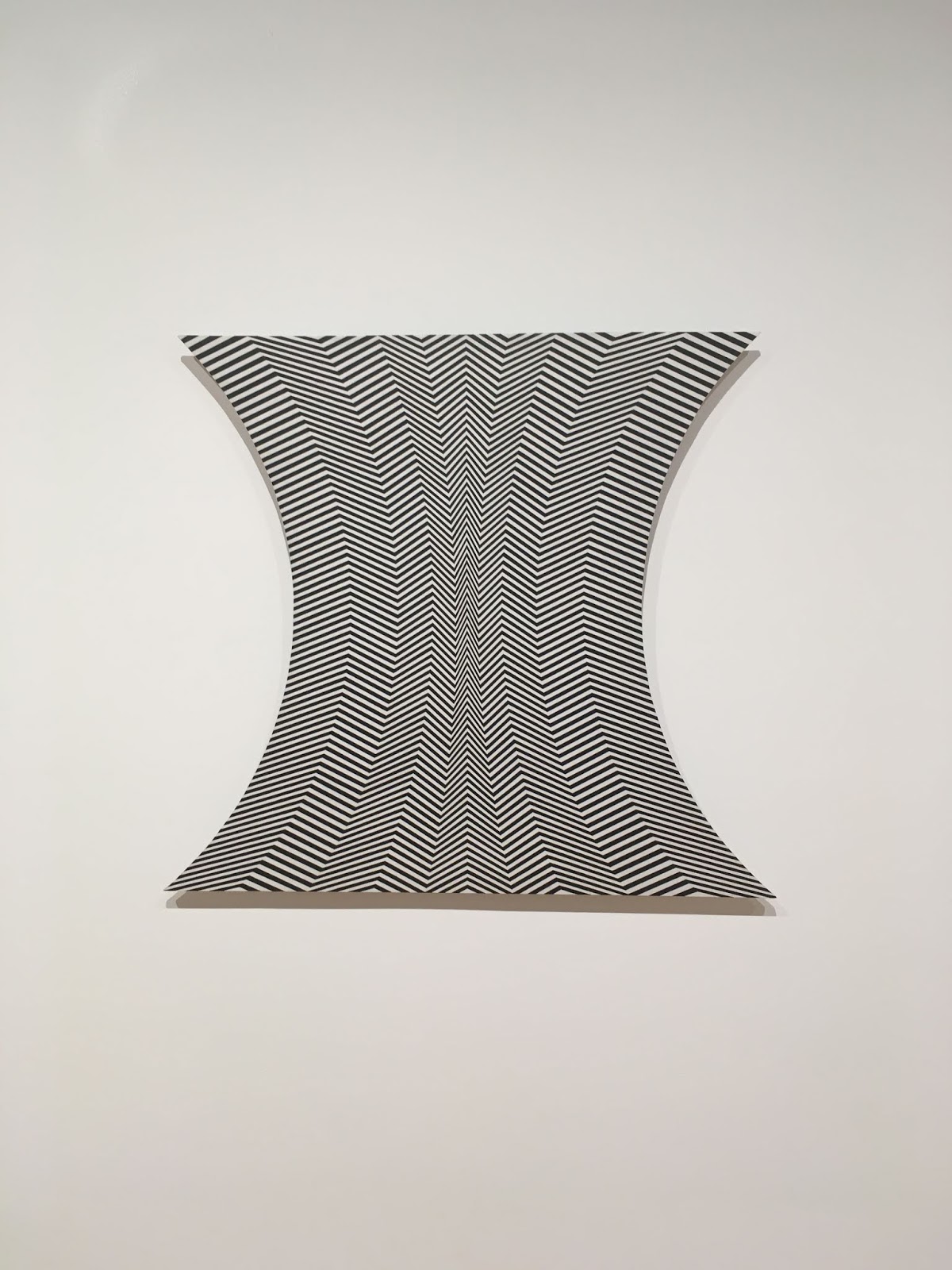
Shape shifter: Bridget Riley at the Hayward Gallery

A 'photo-blog' this time, following my visit to the Bridget Riley retrospective exhibition, running at the Hayward Gallery in London's Southbank Centre until 26 January 2020.


Riley's work was among the very first abstract art I loved. While I had no idea what 'op art' was at the time, I always loved 'optical illusion' puzzles and curiosities as a kid. No surprise, then, that I've always been mesmerised by Riley's manipulation of colours (or the lack of them) and shapes (or the spaces between them) - and the grand scale on which she achieves it.

Here, I'm going to take you on a short tour of some of my highlights of the show. Nothing - not even a copy of the handsome catalogue - can really replace going to see the pieces in the 'flesh'. You have to imagine many of them filling your field of vision, or being able to get close enough to see the subtle variations in the lines and patterns, or marvel at the brushwork's precision in the service of such restrictive, rigorous designs.


The dazzling black and white images - surely her most recognisable work to this day - have this almost frightening ability to make you see false shapes, or a third dimension that isn't there, especially as you move forward and back or side to side in front of the painting. In some cases, I had that weird sensation not unlike when the eyes of a portrait seem to follow you around the room - but here it's a void that responds to your actions. Then I think the art touches on something almost terrifying, apocalyptic.


As a comprehensive survey, the exhibition covers some aspects of her career that I hadn't previously been aware of - for example, her admiration for Seurat. While the art she went on to produce doesn't resemble Seurat's, she was influenced by his approach - and the curation does its best to tease this out:


We also get to see some of her very early pieces...


I was fascinated to see signs in the 'pre-abstract' work of possible later preoccupations: the 'rejections' of the face, each hidden, altogether missing, or fading, somehow incomplete; shapes and their shadows; geometric lines.

The show also took in some less familiar media - for example, some of her works on perspex (where the images feel almost like trademarks or esoteric logos of some kind), and her only 3-D large-scale installation, where you can walk inside and be surrounded by a Riley painting - notwithstanding the short queue, very few people stayed in there for long!


But the more familiar I am with an artist and the more I go to see their work, the more easily I can let my mind wander onto other aspects ... in particular, the 'hang'. I was struck by how sometimes an exhibition can find its perfect gallery, and that has definitely happened here. My final sequence of snaps is meant to give you an idea of just what it was like to move around in the space and experience these pictures: surely the white and grey austere lines of the Hayward were just waiting for Riley to come along.

(Brief warning - as this is a little like street photography with a roof, I'm anxious that no-one in the photos can be readily identified. As a result, I experimented with the editing functions on my laptop and, in an unexpected turn of events, managed to completely remove two peoples' heads. I've actually left these individuals in the pictures as a kind of tribute to Riley's erasure of faces. Please rest assured that I didn't actually decapitate anyone in the gallery to achieve my aesthetic aims...)

I hope you've enjoyed the photographs. You can find details of the exhibition here on the Southbank Centre website.