Saturday, 15 October 2016

Private views: William Eggleston, Georgia O'Keeffe

If you're London way, there is still just time to catch two vastly different, but equally dazzling, exhibitions: William Eggleston's Portraits (at the National Portrait Gallery for another week) and Georgia O'Keeffe (at Tate Modern until 30 October). I haven't managed to write about these nearly as quickly as I'd hoped - but I still thought them worth drawing to your attention, since the book accompanying the Eggleston photographs in particular is well worth your time.

Eggleston is, in my opinion, rightly celebrated for his impassive gaze at Americana, and I can see why he's been compared to, say, Hopper in achieving that sense of detached melancholy (in film rather than paint, of course). WE does not confine himself to photographing only people - far from it. But as regular Specs perusers will know, portrait photography is something I'm very fond of doing myself, so the opportunity to see a large amount of his work in this genre and gain some inspiration from it was irresistible.

Photograph an empty location, and you can capture stillness. But once people are in there, movement or change is always implied - there cannot be total disengagement. The two 'forces' going on in many of these pictures, then - WE's apparent 'attempt' (deliberately subverted, I'm sure) to shoot his subjects with the same coolness as his landscape work, and the simple fact of their energy and presence pushing against this - make for a wonderful tension. If anything, I thought of film-makers: the saturated false normality of Lynch, or the eerie symmetry of Kubrick.

Take the shot below. At first glance, it's tempting almost to laugh at the old-fashioned hairstyle and see the photo as almost satirical, condescending. But that tight vertical line of focus shows the similarity of the grips and the necklace. Geometry is in evidence everywhere here - follow the lines from the corners of the near seat, through the corners of the far seat, to the 'corners' of the hairdo. The friends/couple are merged into one shape, making two opposite triangles, giving them a deep connection without ever needing to reveal their faces. The only thing breaking this balance is that the two cigarettes (both somehow 'equally' out of focus) mirror each other 'into' rather than across the picture, lending the subjects an even stronger link.


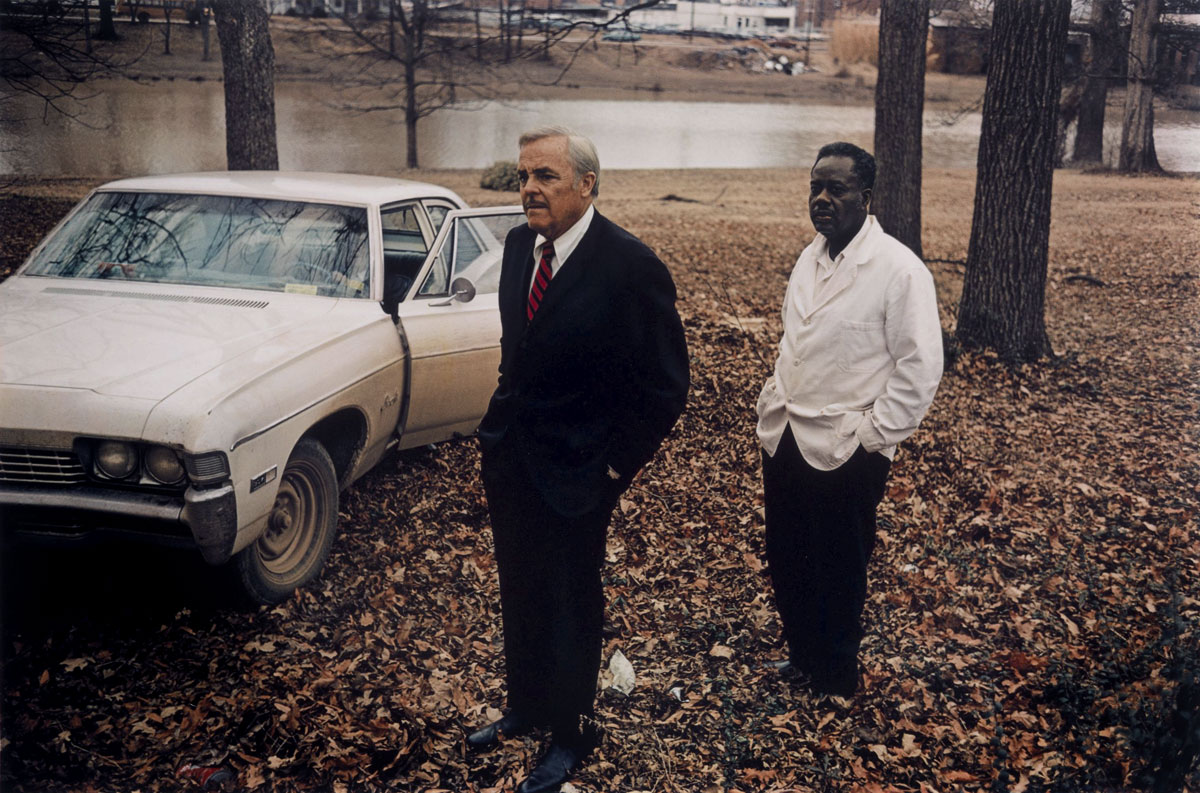
For an extraordinary marriage between people and their surroundings, I'd be hard pressed to find a more eloquent example than the next photo. The loyal manservant falls naturally into the body language used by his boss. But notice how the men are echoed by the pairs of trees receding into the distance to the right - particularly the closer pair suggesting the one on the right is the sturdier of the two. I'm also struck by how there are only really three colours in the photo - the inescapable black/white contrast picked up in the car and its radiator, the house in the distance, the clothing... and all else is an autumnal shade, as if this situation is transitory: the white man's skin in fact the same ruddy brown of the leaves, earth and even the water.

From image to image, I just found myself marvelling at the photographer's eye. His seemingly instinctive way of capturing people at exactly the right time and place even allowed for some gentle humour: the girl in the back of a car, placed so accurately that the windows of the car spread out behind her like angel wings - but in a perfect inversion of the shape of her curved specs. Or, in one of my favourites from the whole exhibition (below), an early shot of a man about to cross the road, near a STOP sign. But the man also is the STOP sign in human form - the timing is such that his awkwardly raised leg, mid-gait, puts his rigid frame at the same slightly-skewed angle.


Sometimes Eggleston's self-removal is problematic - the photograph of his girlfriend in tears, staring accusingly down the camera lens, is uncomfortable and unforgettable - and we occasionally feel like we're witnessing scenes we perhaps shouldn't. But in a way, I'm glad that someone who seems to have lived a life at the edges, quietly observing, is also capable of edginess - otherwise it would be easy to believe he has somehow moved among us completely unnoticed, leaving no trace but his photos. One of the most thought-provoking and involving exhibitions I've seen in years.

After these smaller-scale wonders, Georgia O'Keeffe's paintings came as a kind of blissed-out, sensory overload. I had perhaps the same pre-conception of O'Keeffe as many others - I knew her name, and of her importance, but the only pictures I really knew about were the large flowers. Much like this one:


So, one of the glories of the Tate's exhibition is its ambitious scope - GO'K's whole lifetime is covered, and the outsize flora take their place as part of her never-ending cycle of artistic development.

I will get one thing off my chest about the 'hang', so to speak - or perhaps, more accurately, the curation. GO'K's quotation "Men put me down as the best woman painter... I think I'm one of the best painters" features prominently on the posters - and it's been assembled by two women. So, while being aware that as a chap, this is not my field of expertise or comfort zone, I was expecting a full-on feminist, celebratory approach of Keeffe's originality and brilliance. I wasn't expecting quite so much focus on her husband, Alfred Stieglitz, photographer and artistic mover/shaker. Clearly, they were important to each other, but after a few rooms, I was finding Stieglitz to be something of an annoyance. For example, while O'Keeffe seems to have willingly acted as his muse, did we really need to see so many of his photos of her - isn't that his work? Or the fact that they both produced city scapes (like the painting below) is surely not cast-iron evidence that he was an inescapable influence, but rather a natural outcome of the fact they both lived in a city. Worse, he apparently perpetuated and galvanised the tendency of critics to see G'OK's work as erotic, irritating her no end. I don't want him airbrushed completely out of her story, but I resented his material taking up space that could have been given to more of hers.


It seems to me that O'Keeffe's work is more about the sensory, rather than the sensual - the paintings suggest heightened levels of experience, rather than contrived layers of meaning. Some of the most breathtaking pieces early on in the exhibition are her abstracts inspired by music: communicating what synaesthesia (the condition that allows people to experience a stimulation 'across' the senses - for example, to see music as colours or shapes) might actually be like for those of us in the relative dark. And the famous large-scale flowers - which were also subject to the 'sexual' over-simplification - in fact force the viewer to engage with the plants' beauty and intricacy to a hyper-real extent, since it would be impossible to experience the bloom in such overwhelming dimensions in the wild.


As time went on and O'Keeffe moved herself physically further into nature - initially the rural Lake George area of New York State and ultimately her extended stays in New Mexico - the art became not so much surreal as more totemic, emblematic. The exhibition finds room for her skulls and bones, shown almost levitating against the bright landscape, like bleached-out, sun-drenched vanitas still lifes... contrasting with her 'Black Place' paintings of remote, monochrome hills. Telling details zap you like lightning bolts from her abstract work - as below, where the interlocked sections of bone are echoed by the fissures in the distant rock face.


One of my own favourite paintings is far less elemental. But this East River view, I think, combines so many features of her greatness. I love the way the entire view is slightly slanted left, as our eye rarely sees everything as totally flush and horizontal. The buildings, while totally realistic, strike us as a pattern of recurrent, near-regular shapes, seemingly with the potential to repeat and regenerate for ever. And her billowing clouds are present in the smoke pouring from the funnels and chimneys. In the haze, the hue of the open land far off picks up the colour of the water. I couldn't tell you how long I stood transfixed, staring into this.


Two artists utterly poles apart in attitude and approach: disinterested observation versus deep engagement. But both seem to arrive at the same instruction - stop, and look more closely.


Saturday, 8 October 2016

Cross purposes: 'Norma' at the ROH

Bellini's opera 'Norma' is justifiably famous for at least two reasons: as one of the most highly-regarded works in the 'bel canto' genre (an especially florid style of Italian singing - gorgeousness almost for its own sake), and having, in the title role, one of the most demanding parts in the entire repertoire.

The new production of 'Norma' at the Royal Opera House had already made the headlines long before the actual run. Anna Netrebko withdrew from debuting in the role about a month after the season was announced. However, within a week or so, Sonya Yoncheva - also taking on Norma for the first time - had been cast in her place. This generated a bit of 'BUT IS SHE A NORMA?'-style speculation (surely it's the same with any new incumbent of this particular role). But as someone who is happiest when their corner of social media is in 'polite' mode, I was really pleased to find that most reactions I saw to SY's involvement were of curious, optimistic interest.

I was excited, too, because I knew SY only through her lovely album 'Paris, mon amour' - I'd never heard her live on stage. And I was particularly intrigued by the swift return to the ROH of director Àlex Ollé (of La Fura dels Baus, the troupe behind the brilliant recent production of Enescu's 'Oedipe', which I wrote about here).

To canter briefly through the plot... the Romans have occupied Gaul. The Druids are governed by a kind of first family, namely Oroveso, their chief, and his daughter Norma, their high priestess. These aren't the chilled-out hippy Druids you'd expect to find hanging around Stonehenge; in fact, under Oroveso's leadership, they are itching to make war on the invaders. Norma advocates peace, not least because she has had two children on the quiet with a Roman lover, Pollione.

Pollione, card-carrying complete bastard, has actually transferred his affections to another, junior priestess called Adalgisa. Adalgisa puts up some resistance, but ultimately agrees to leave with Pollione. However, she feels the need to explain her impending departure to Norma. The truth comes out just as Pollione turns up to collect Adalgisa, and there is, of course, an almighty dust-up. Both women are furious to find out about Pollione's deception - so he leaves by himself. But Norma's rage is apocalyptic.

She comes very close to killing their children in a Medea-like act of revenge, but stops herself. Adalgisa returns to her vows after failing to persuade Pollione to come back to Norma - at which point things, as they say, escalate quickly. Hearing that the Romans plan to take Adalgisa back by force, Norma stirs the Druids up to war. Pollione is arrested and brought in after being caught breaking back into the temple. As a sacrificial victim is needed for the war ceremony, Norma shocks the entire ensemble by revealing her secret - including her children, for the first time, to hands-off granddad Oroveso - and proclaiming herself as the offering. She dies with Pollione on the pyre.

High octane stuff. But - as a 'bel canto' high watermark - however sorry or tense the situation, it's all underpinned by utterly gorgeous music. If, like me, you're a bit more used to later opera where the orchestra tends to track the mood of the action more closely, it can at times seem a little surreal or ironic, as if the score has passed through music written since and out the other side.

But of course, it's neither of those things. As the convention of the time, it would not have had this strangeness-in-hindsight. And the cast, playing it completely straight, bring out a total sincerity. Somehow, the loveliness of the melodies makes it more unbearable that this is happening to these people. Norma has a rightly-celebrated solo aria 'Casta diva', where she prays for peace. But for me, this was possibly surpassed by the writing for duet and trio near the end of Act I - where first, Adalgisa's confession and Norma's compassion ripple over each other until realisation dawns, then - once Pollione turns up - their fury erupts, but in sublimely intertwined lines: as any two voices fall back, the third fills the gap to take its place in the argument.


(The ROH's clip of Sonya Yoncheva singing 'Casta diva'.)

Sonya Yoncheva was magnificent. No problem supplying the seemingly effortless beauty in the voice, but also dominant and commanding when necessary. I was convinced by the body language and attitude that this was someone who could control and influence a mob. She gave the character moments of fearsome physicality - a cry of rage at the exact moment the lights went out on Act 1, and later on, an unchecked assault on a gong, when in war mode. The supporting cast were all on form, too. Sonia Ganassi (apparently performing with a cold; still great) brought out the initially weak and anguished Adalgisa's latent grit, and Joseph Calleja was suitably thuggish as arch-git Pollione - terrific sound, but if I had to change one thing, I'd get him to interact with the other characters more, rather than declaim outwards quite so much. (This, of course, could have been how he was directed.)

I was also hugely impressed by the staging and production. The forest, gleaming in darkness, seems very strange and stylised, until you realise the trees are made entirely of what must be hundreds of crucifixes. (A chilling realisation of how the wood is described by Pollione and his friend Flavio as evil, containing death.) The 'Druids' in this production are definitely being aligned with Christianity - it's hard to miss the comment on aggression/repression in contemporary religion - but the specifics are nicely blurred: the swinging censer and tree-crucifixes might suggest Catholicism but if so - Norma and Adalgisa would not be priests.


Ollé revisits some of the time-shift concepts that helped make his 'Oedipe' production so fascinating. In the first half, the characters wear vaguely recent/contemporary military and clerical garb... but after the interval, Norma's children are shown in an ultra-modern flat, with 'Watership Down' on the TV (as if these kids aren't traumatised enough!) and a spacehopper taking centre-stage. Church and state seem to blur further as Norma and Adalgisa appear in business-like trouser suits, religion and war now a matter of admin - of getting things done.

To me, this meant that every aspect of the opera carried a tension between what things 'ought to be', and what they are. I've already mentioned the way the divine music can seem a mismatch for the ugly subject matter, and Ollé's overall production looks to that model. All the individual elements we see make sense: the costumes, the props, the locations... but they only 'add up' in the opera's alternative universe where we find ourselves. We can absorb the critique of today's society, without missing out on that wave of escapism opera gives us, as a modern audience.

The final image of the production is an astonishing coup de theatre, as the partially-hidden sacrificial pyre itself takes the shape of a stage-high burning cross - queasily reminding the audience of the Druid's KKK-style headgear and finally igniting the underlying theme of where fundamentalist rule inevitably leads: to death. And more than that, to death of the innocent.

An evening of real depth and power, stunningly performed and realised.

Tuesday, 27 September 2016

Lieder column (slight return)

A while ago now, I wrote a couple of Specs posts which each looked at different performances of a particular art song. I was planning to carry on this occasional 'Lieder Column' series and - world-class pun notwithstanding - intended to look at not just German song but also French 'mélodies' along with favourites from any other nation I cared to aurally visit.

I'm not sure what happened, but I never really got back to it. Clearly other, subsequent posts all seemed more pressing or topical at the time, and got in the way. And in passing, I have a feeling - though I could be wrong - that there isn't quite the dizzying variety of versions on YouTube that there used to be, with copyright restrictions making some videos 'unshareable', or simply absent.

So I was delighted to be included in an ongoing Twitter enterprise called 'Some Of My Favourite Songs'. Each participant posts one song a day for a week, before handing the baton on to someone else. The hashtag is worded very kindly, as to try and think of this as one's definitive 'Top 7' is agonisingly restrictive. Schubert, widely regarded as the master of the form with more than 600 songs to his name, is my favourite composer for a start: I could probably have reeled off a top twenty without thinking about any other contenders at all.


With this in mind, while there are no 'rules', I imposed a couple on myself. 1 - I would post a different composer each day. 2 - I would try and choose songs where I also admired the performance, as well as the piece itself. It was enormous fun - not without the odd frustrating moment (*shakes fist at YouTube*), but overall a glorious excuse to indulge in ceaseless, bite-size portions of bliss.

I thought I would archive my seven choices here on the blog - and (as it's MY blog) upscale it slightly to a selection of 10 songs. The final three were 'bubbling under' but didn't make the cut (if only because I would've repeated a composer.) I hope you enjoy them.

Debussy: 'De grève' (at 6:51), performed by Christine Schäfer and Irwin Gage. (I think this might have the most extraordinary closing moments of any song, by anyone.)


Mussorgsky: 'Serenade', performed by Ekaterina Semenchuk and Natalia Mordashova.


Hahn: 'A Chloris', performed by Susan Graham and Malcolm Martineau.


R Strauss: 'Das Rosenband', performed by Carolyn Sampson and Joseph Middleton. (From one of my favourite CDs of recent years, 'Fleurs'.)


Schumann: 'Mondnacht', performed by Christa Ludwig and Erik Werba.


Maconchy: 'Ophelia's Song', performed by Caroline McPhie and Joseph Middleton.


Schubert: Auflösung (at 1:07:58), performed by Christoph Prégardien and Andreas Staier. (Extraordinary that this album - to me, an absolute classic - is on YouTube in its entirety. At the time of writing, a certain online retail behemoth is offering it on download for only three quid! My favourite song changes all the time, but this is right up there - I love so many versions of it, but CP's impeccable performance and even more so, AS's chiming fortepiano give this one the edge.)


R Strauss: 'September', performed by Barbara Bonney and Malcolm Martineau. (I can't resist the voice/piano version of this famous 'Last Song'.)


Schubert (arr. Reger): 'Litanei auf das fest Aller Seelen', performed by Ruby Hughes, with the BBC Philharmonic Orchestra (Juanjo Mena).


Schumann: 'Widmung', performed by Leontyne Price and David Garvey.


Please visit the #SomeOfMyFavouriteSongs hashtag to hear more excellent choices. A huge thank you to all my Twitter friends involved, who are proving on a daily basis that the pleasure of the thing is as much in the listening as the choosing.

Sunday, 18 September 2016

Star chamber: Sampson, Davies & Middleton

In my previous post, I wrote fondly about the range and scale of the Proms - which to many people, for better or worse, is summed up by the epic extravaganza of the Last Night and the vast rotunda of the Royal Albert Hall.

The venue that thinks it's a steamer hosted 74 of the concerts this year. Even though we managed to take our holiday right in the middle of the season, I still made it to some fine performances.

There was a sublime evening of Mozart and Mendelssohn, courtesy of soprano Rosa Feola and Le Cercle de l'Harmonie. The BBC Philharmonic under Juanjo Mena presented a thrilling programme of Ginastera's 'Ollantay', Steven Osborne having a high old time with Britten's Piano Concerto, then rounding off the evening with Schubert's 9th. More Mozart - the Mass in C Minor - with four superb soloists (Louise Alder, Carolyn Sampson, Benjamin Hulett and Matthew Rose) supported by the BBC Symphony Chorus and BBC Scottish Symphony Orchestra, conducted by Ivan Volkov. Finally, I felt very lucky to have seen the City of Birmingham Symphony Orchestra's Prom, under the thrillingly dynamic leadership of their new music director Mirga Gražinytė-Tyla: an unstoppable whirlwind on the podium (mostly conducting without score), we heard the Magic Flute overture and Tchaikovsky's 4th Symphony - plus US soprano Barbara Hannigan singing the London premiere of Abrahamsen's 'let me tell you' song cycle. It was fascinating to see BH - renowned herself as a 'force-of-nature' performer - assume the role of the 'still presence' on stage a few feet away from MGT's constantly-alert, detail-seeking energy.

But what I really want to do here is turn the focus away from the Royal Albert Hall for a while. After all, this year also witnessed Proms in the Sam Wanamaker Playhouse in Shakespeare's Globe, the Roundhouse in Camden, the Old Royal Naval College in Greenwich - and a multi-storey car park! As someone who (as regular readers will know) attends a lot of smaller-scale concerts - especially classical art song - I always pay particularly close attention to the Chamber series, which take place on Monday lunchtimes at Cadogan Hall, just off Sloane Square. (I've been advised that the BBC are 'unlikely' to adopt my genius marketing idea of calling this series the 'Tiddley-Proms'. You can't help some people, etc.)


And sure enough, this year the final chamber concert of the season was my undoubted Proms highlight of 2016. For a start, it featured three favourites of mine: soprano Carolyn Sampson (again!) and countertenor Iestyn Davies, with Joseph Middleton on piano. There were three strands to the programme: songs by Purcell/Britten (Britten, a huge admirer of Purcell, 'reconstructed' a large number of songs for which the earlier composer had left only sketches - so they sound suspended between centuries), Mendelssohn and Quilter.

While love - and the bliss or angst it can bring - bound many of these selections together thematically, the programme also had a quality of 'unearthing' about it. Just as Britten excavated the Purcell works, in the bright afternoon of the Cadogan auditorium, it also felt as though the concert was also bringing to light two other song composers who may not have had their full due. Petroc Trelawny, presenting for BBC Radio 3 from the stage, drily remarked that Mendelssohn may be the only composer whose 'Songs without Words' were more famous than those with them.


I was on a high after this gig for days. It seemed a perfect hour of music-making. The songs were chosen were, without exception, not just beautiful but interesting - whether Mendelssohn's mastery of a last-minute mood change (putting on the brakes near the end of 'Neue Liebe') or Quilter's light-operatic nod towards something resembling a show-tune ('Love Calls Through the Summer Night'). There was good balance between duets and solo spots for CS and ID, so that each singer had plenty of opportunity to shine individually, before coming back together to deliver astonishingly tight - and fast - harmonies. The soprano and countertenor ranges are close enough neighbours for both parts to dovetail around, above and below each other... or blend seamlessly - and so they did.

It's also important to note how strong the rapport was between all three. Clearly, this was most obvious between Sampson and Davies, as the voices upfront. I really appreciate the fact that - even though this was a 'small' gig (massive radio audience, of course, but seen only by we privileged few in the Hall), the pair had taken the time to work out how to act their parts and bring the songs to life visually. I don't take this sort of thing for granted - it would have been quite in order to perform the songs in stricter 'recital' style and it would still have sounded glorious. But they seemed to be having too much fun.


The Purcell/Britten songs perhaps brought this out the most. ID's ability to mix a little tension and edginess into the purity of his tone (as well as his body language) was perfect for his helplessness in the face of love for 'No, resistance is but vain'. This was immediately followed by the extraordinary 'Celemene, pray tell me' - CS moved away from ID as our applause for the previous tune faded - however, with she at her most seductive and he at his most impassioned, they spend the song failing the stay apart. At the censor-troubling climax ("My breasts do so heave" / "My heart does so pant" / "There's something more we want"), Sampson shielded Davies from the audience in a suggestive embrace. (If you listen to the radio broadcast - and you really should - you can hear the nervous laughter of an audience trying to applaud while loosening their collars.)

Separately, both singers were captivating. You know you will be in such safe hands during the Purcell: ID imbuing 'Music for a while' with steel as well as sensitivity, and CS singing 'If music be the food of love' with signature beauty and clarity. But equally rewarding was the Mendelssohn section, with ID's searing performance of 'Scheidend', followed by CS bringing a kind of delicate terror to 'Neue Liebe'.

This particular song leads me to Joseph Middleton, who matched his co-performers every step of the way. In 'Neue Liebe' he has to move particularly fast, peeling off agitated runs without overshadowing the singer, and it comes off handsomely - even the closing swerve where the song slows nearly to a halt before a final flurry of accompaniment has to emerge from behind the voice. Another standout performance for me was 'Love's Philosophy' - Quilter has written in the ripples and waves of the water featured in the lyrics, and JM captured the perfect dynamics for this, with the 'swells' audible, surging into the gaps in the vocal lines.


Regular readers will probably recall my admiration for JM - with CS he put together one of my favourite CD of recent years ('Fleurs' - which I wrote about here), and has a flair for programming and collaboration equal to the versatility of his playing. He's assembling a really fine, fascinating body of work: see also the Myrthen Ensemble's 'Songs to the Moon' (I very much approve of the idea of classical musicians forming 'bands' and making concept albums - brave new world!), and the lovely recital disc 'Nocturnal Variations', where he accompanies Ruby Hughes. He's also the pianist on a superb recent release of the Britten/Purcell collection, and I understand the follow-up to 'Fleurs' with CS is due before too long, as well. Great stuff.

You can still listen to this wonderful concert here on BBC iPlayer Radio - at the time of writing, it will be up on the site for another three weeks. Even better, this particular team announced shortly after the Prom that they were about to record a corresponding disc of duets - on the evidence of this performance, it'll be a must.

(Photos of Carolyn Sampson and Iestyn Davies both from the Royal Albert Hall website and copyright Marco Borggreve. The photo of Cadogan Hall is from the venue website, and Joseph Middleton from his own website: photographers currently unknown.)

Sunday, 11 September 2016

About Last Night...

There it goes again, for another year. Last night was the Last Night of the Proms. Has the season absolutely flown by - or does it just feel like that to me because we went on holiday in the middle of August? A great trip, don't get me wrong: but I do remember feeling slightly agonised at a few of the concerts I was going to have to miss. Luckily, the Proms have enormous reach - every single one goes out live on BBC Radio 3, and the iPlayer gives you a month to catch up on any broadcasts you miss.

It's when I blithely type in a sentence like that last one, and ponder its full implications, that I realise just how lucky we are to have the Proms. A single festival that stretches across multiple venues hosting some 80 concerts. Over 70 of these are in the Royal Albert Hall, where standing tickets are available on the day for £6. (And in 2013, I saw five Wagner operas in one week, on a pre-booked 'season ticket' costing £32.) National and international audiences can hear every concert for free on the radio or internet, and some of the gigs make it to TV - either intact or in excerpts thanks to the 'Proms Extra' magazine show aired during the season.

However, to many people the Proms 'is' the Last Night, with all the baggage that entails. I wasn't there in person, but (like a lot of folk, I imagine) saw most of the TV broadcast with one eye on the concert and the other on social media. Much of the comment was enthusiastic, but the web is not a joyful place, and I was dismayed - as I still, always, naively am - at the sneering, jeering, contemptuous positions adopted by the eternally-offended: in this case, by those who claim to find the traditional flag-waving, sing-along closing stages of the event jingoistic, reprehensible or problematic.

I know this has not been an ordinary year. The Brexit vote led to speculation that the Last Night would have to adopt some kind of special tone - but what? More 'gung-ho' or more 'oh no'? Whether you take a 'little England' view that the Last Night is a shrine only to Britishness OR you find the very notion of cheerful patriotism distasteful in a year of such political upheaval - both of these camps are overlaying the way they think and feel onto the format of a concert that has remained largely unchanged for decades. Also - as so often these days whenever opinions are expressed - some important nuances get overlooked.

To begin with, in the creative fields, we always have, and always will, enjoy things that are 'problematic'. We so often separate music from the views or behaviour of its makers (from Wagner to Miles Davis). We laugh at scabrous, shock-tactic comedy which has its cake and eats it by 'shining a light' on characters it supposedly despises. We acknowledge the fine line trodden by much art and film between elevation and exploitation. To put it rather bleakly - if it's something we like, we find a way to justify it. But in the end, this becomes a necessary decision for us all to be able to consume culture with a clear conscience. It would be lovely if the murky smog of our past didn't carry the whiff of empire, but it does: and it still would, whether we sing 'Rule Britannia' and 'Jerusalem' once a year or not.

(As an aside - I can't be the only person who is irked when music and the arts are held to this kind of scrutiny when sport so clearly isn't. In this Olympics year, it's been made perfectly clear that beating other nations at things is apparently a wonderful thing that should be widely and justly celebrated. Also, Match of the Day's presenter - not for the first time - tweeted a moan about the Prom over-running into their football coverage. Irony or doltishness? Toss a coin. Anyway: music is innocent - as I shall argue.)

I've been to the Last Night once, and I felt the atmosphere and behaviour there had virtually zero to do with jingoism. The television broadcasts for once don't help here, because they only show the second half of the concert on our main channel, BBC1 - foregrounding the closing section and ensuring it still may be the only bit that totally casual viewers really know about. The first half goes out on BBC2.


Certainly, it feels more like a party than a concert (the point has been raised that it's misleading, in that it doesn't resemble all the other, more serious Proms - but who wants the last day of term to be just another school day?) ... and there is something about that sequence of British classics that 'gets you right here', nourishing those old-fashioned feelings of pride and belonging. But what's being celebrated is not 'Britain' - but the Proms themselves, in all their multi-national, inclusive, wide-ranging splendour. The overall season represents a handsomely broad church - it attracts the most admired and renowned performers and orchestras from all over the globe; as well as classical (orchestral and vocal), it makes room for jazz, gospel, soul and rock. It champions new classical music, often played by young musicians, and programmes contemporary pieces alongside old warhorses, so the fresh stuff gets a hearing. It takes outreach seriously, linking concerts to children's television and music education. Even the loyal and attentive audiences are rightly famous, not least the Prom season ticket holders who doggedly stand through as many of the gigs as they can physically get to, even as the Albert Hall reaches temperatures comparable to the surface of the sun.

And the Last Night - across both halves - always brings this together in microcosm. It's only been conducted once by a Brit this decade, and this year by Finnish maestro Sakari Oramo. Youth players got the chance to perform a specially-commissioned new piece at the very start (Tom Harrold's 'Raze'), while 16 emerging singers later performed Vaughan Williams's 'Serenade to Music'. The Peruvian star tenor Juan Diego Flórez added Latin American hits to his Italian operatic arias - then, in a gesture of eloquent satirical genius, sang 'Rule Britannia' in full Inca regalia: a lovely mix of the clever and utterly ridiculous. Meanwhile, Last Night audiences, in particular the 'Prommers' standing in the arena, have been undercutting the patriotic bombast of the event for years. Some of this is, of course, deliberately daft: bobbing up and down, or mock-wiping their eyes. But it's always worth noting that the flags being waved represent a host of visiting nations as well as the UK (and EU).

Should we be proud of such a monumental achievement? Yes, I think it's worth celebrating. It's pointless to call the Proms the 'best' music festival in the world - there are too many different kinds of people and music for that statement to have any meaning. But it is 'up there' as a total success on so many fronts: its excellence, its scale, its range, its accessibility, its appeal and its prestige. As ever, music is where we find the hope, and the glory.

Sunday, 4 September 2016

Radio days (for the diary): Opera on 3

Calling any opera fans who can tune into the UK's BBC Radio 3, or use the BBC's catch-up listening service, iPlayer Radio...

I realise I'm probably very late to this myself and that some of you will have these details already. Never mind, though! 'Opera on 3' - Radio 3's regular slot for broadcasting operas in their entirety, recorded live (and sometimes actually live) - is about to return after its summer break.

Recently, the Royal Opera House announced which of its productions would feature in the strand in the next few months - which prompted me to check if the BBC website had published the schedule for all the other broadcasts as well. And - hurrah! - so they had (please note that all start times are UK time.)

For those of you who might be unfamiliar with iPlayer, take note that you have a full 30 days to listen to the programme from the date it goes out. Which means that you can still go out yourself on Saturday nights if you want to - the opera will still be there when you get back.

Here's the list - hope you find it useful. The ROH does seem to utterly dominate, but there are some interesting and enticing contributions from elsewhere, too.

Saturday 17 September, 6.30pm
Rossini: 'The Barber of Seville' ('Il barbiere di Siviglia') (Royal Opera House)

Saturday 24 September, 6.30pm
Britten: 'The Rape of Lucretia' (Glyndebourne)

Saturday 1 October, 6.00pm
Wagner: 'Tristan and Isolde' (ENO)
(I was lucky enough to see this. It was surrounded by a lot of 'distractions' - its sets by the artist Anish Kapoor, its costumes, its director Daniel Kramer who is now ENO's Artistic Director overall, ENO's ongoing problems - all of which seemed to bend people's reactions this way and that. But the singing was sublime, I felt, and this is a welcome opportunity to just close one's eyes and listen - especially with Edward Gardner conducting. My write-up is here. I do hope they also recorded the ENO 'Jenůfa', which I saw the same weekend.)


(Photo credit: Catherine Ashmore, from the ENO website. Act 1 of 'Tristan and Isolde'.)

Saturday 8 October, 6.30pm
Berlioz: 'Beatrice et Benedict' (Glyndebourne)

Saturday 15 October, 6.30pm
Massenet: 'Werther' (Royal Opera House)
(I loved this production and found the opera - which was new to me - completely fascinating. Interesting casting as well - two leads who so often come across as buoyant, winning personalities playing this brooding psychodrama against type. Write-up here.)


Saturday 22 October, 6.30pm
Verdi: 'Il Trovatore' (Royal Opera House)
(I hadn't seen this classic all the way through before going to this production, and was just astonished at how like attending an operatic 'greatest hits' it really is. Ekaterina Semenchuk made me come over all unnecessary, which possibly means I have a thing for vengeful gypsies, or that perhaps - as a friend nobly pointed out - I am a "chest man". Chest voice, he means. Obviously.)

Saturday 29 October, 6.30pm
David: 'Herculanum' (Wexford)
(Very intrigued by this - an opera that seems to have disappeared for over a century. Now this will be the second new production in the last three years.)

Saturday 5 November, 6.30pm
Bellini: 'Norma' (Royal Opera House)
(This made slightly unwelcome headlines because Anna Netrebko decided to withdraw - so listen in your BILLIONS to support Sonya Yoncheva take on the infamously difficult title role.)

Saturday 12 November, 6.30pm
Mozart: 'Cosi Fan Tutte' (Royal Opera House)

Saturday 26 November, 6.30pm
Britten: 'Billy Budd' (Opera North)
(Unbelievably excited about this - Mrs Specs and I are making a special trip to Edinburgh to see Opera North perform this, plus a Puccini double bill, in early December. So this will give us a sneak preview. Roderick Williams takes the title role.)

Saturday 3 December, 6.00pm
Puccini: 'Manon Lescaut' (Metropolitan Opera)
(I think this will be going out live - a Saturday matinee in New York - and does feature Netrebko!)

Saturday 14 January, 5.45pm
R Strauss: 'Der Rosenkavalier' (Royal Opera House)
(Enormously appealing cast for this great masterpiece - will be hoping to see it in person. Two of my favourite singers feature - Alice Coote as Octavian and Matthew Rose as Ochs - with a chance to see Renee Fleming in one of her signature roles as the Marschallin. Brilliance also in the support, including Sophie Bevan and Wolfgang Ablinger-Sperrhacke.)

According to the Royal Opera House website, two more of the season's productions - Shostakovich's 'The Nose' and Offenbach's 'Les Contes d'Hoffman' - will also be broadcast, with details to follow. I'll add the information here once I spot it, then flag the updates.


Sunday, 28 August 2016

Tinted Specs

The photo project continues (see Specs passim - I've always wanted to type that)...

As regular visitors to this corner of the internet will now know, my current longish-term photographic portrait series involves my friends and willing subjects/victims assuming fictional, musical 'characters' from various periods in the 20th century. For two specific incarnations I had in mind - opera singer and crooner - I was going the furthest back in time and called on the assistance of Fliss and Tony. They are my longest-serving photo comrades, and with their am-dram skills and experience can be relied upon to give truly chameleon-like service (not to mention an array of ace props and costumes!)...

These photos (like all the others in the 'music' project) will undergo further edits and graphic-design assembly... but I'm overjoyed with how the portraits themselves have turned out. It's certainly a fascinating challenge for me to try and eliminate as much as I possibly can of the 'modern' world while still composing a sensible and attractive composition that best serves the model.

Clearly, Tony is in 'Sinatra' mode but we have anglicised him somewhat next to old lanterns and pub-side alleys. Some useful fire escapes also helped us reflect Frank's ability to crop up in front of sky-darkening tenements. Tints abound too - looking through his album sleeves, it's quite a shock to find how often Sinatra appears, to all intents and purposes, in a bright orange, say, or deep indigo.

It felt appropriate to locate Fliss near and around London's two best-known operatic locations... but when the time came to reference a specific work, a simple hostelry interior made do - appropriately enough. Fliss's attire and handful of cards will tell opera fans all they need to know.

I hope you enjoy the photographs.


PS: The opera we were illustrating is Puccini's 'La Fanciulla del West' ('The Girl of the Golden West').